An SAT micro-topic explainer. Free to read — no account needed.
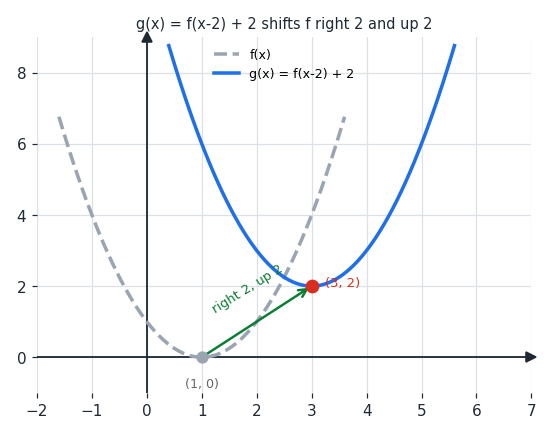
When one function is built from another by shifts, like g(x)=f(x−2)+2, the graph of g is just the graph of f moved. A change inside the function shifts it horizontally, and a change outside shifts it vertically.
Read the two shifts separately. In g(x)=f(x−2)+2, the (x−2) moves the graph right by 2, and the +2 moves it up by 2. So if the graph of f has its vertex at (1,0), the graph of g has its vertex at (1+2,0+2)=(3,2); every point of f moves the same way.
To go the other way and recover f from g, undo the shifts. Since g is f moved right 2 and up 2, the graph of f is the graph of g moved left 2 and down 2. So a vertex of g at (3,2) came from a vertex of f at (1,0).
You can also read a single value of f straight from the graph of g. Because g(x)=f(x−2)+2, putting x=3 gives g(3)=f(1)+2, so f(1)=g(3)−2. Read g(3) off the graph and subtract 2: match the input, then adjust for the outside shift.
Worked examples
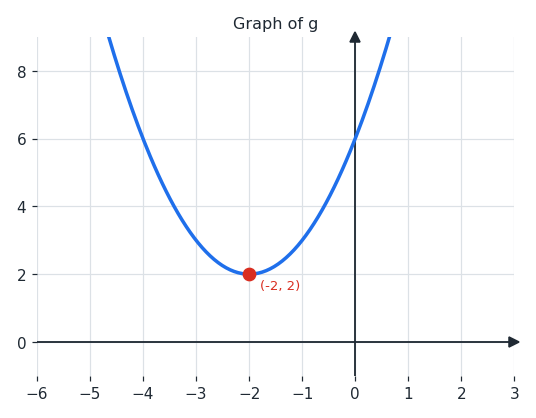
The graph of g is shown, where g(x)=f(x+3)−1. What is the vertex of the graph of f? The (x+3) moves f left 3 and the −1 moves it down 1, so f is recovered by moving g right 3 and up 1. The vertex of g is (−2,2), so the vertex of f is (−2+3,2+1)=(1,3).
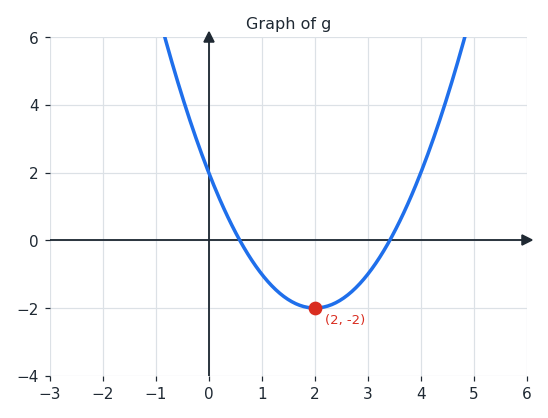
The graph of g is shown, where g(x)=f(x+1)−3. The graph of f is a parabola; what is its vertex? The (x+1) moves f left 1 and the −3 moves it down 3, so f is g moved right 1 and up 3. The vertex of g is (2,−2), so the vertex of f is (2+1,−2+3)=(3,1).
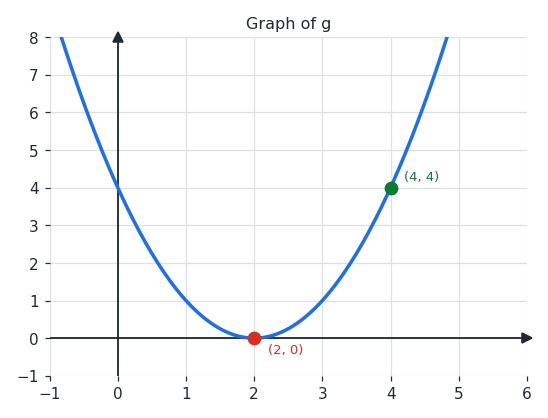
The graph of g is shown, where g(x)=f(x−3)+1. What is the value of f(1)? Since g(x)=f(x−3)+1, set x−3=1, so x=4; then g(4)=f(1)+1, which gives f(1)=g(4)−1. From the graph g(4)=4, so f(1)=4−1=3.
Is this one of the topics costing you points?
Take the free 10-question diagnostic for a predicted SAT score and a breakdown of which domains are costing you points.