An SAT micro-topic explainer. Free to read — no account needed.
Several transformations can be combined into one form: g(x)=af(x−h)+k. Each piece does a separate job, and reading them one at a time keeps it simple. The changes inside the function affect the graph horizontally, and the changes outside affect it vertically.
The (x−h) inside causes a horizontal shift, and its sign is opposite to what it looks like. So f(x−3) moves the graph 3 units to the right, while f(x+3) moves it 3 units to the left.
The a in front is a vertical stretch, and a negative a also flips the graph over the x-axis. The +k at the end is a vertical shift: +k moves the graph up by k, and −k moves it down. For example, 2f(x)−1 makes the graph twice as tall and then lowers it by 1.
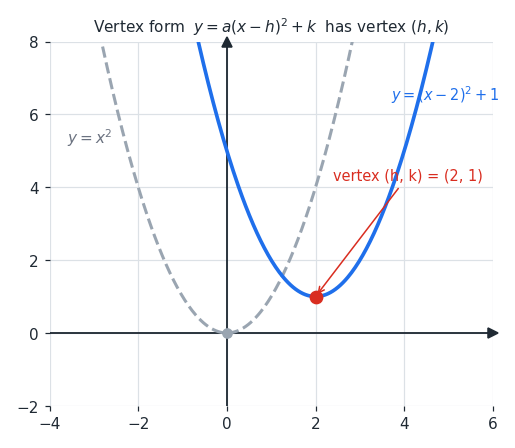
For a parabola, this form is especially useful and is called vertex form: y=a(x−h)2+k. Its vertex sits exactly at (h,k), so y=(x−2)2+1 has its vertex at (2,1).
When several changes appear together, apply them in order. Take g(x)=−f(x+1)−4: the +1 inside shifts f left 1, the minus sign flips it over the x-axis, and the −4 lowers it by 4. Handling one piece at a time avoids mixing up the directions.
Worked examples
How does g(x)=f(x−3)+2 transform the graph of f(x)? The −3 inside shifts the graph 3 units to the right, and the +2 outside shifts it 2 units up. So g is f moved right 3 and up 2.
Where is the vertex of the parabola y=2(x−1)2−4? In vertex form y=a(x−h)2+k, the vertex is at (h,k). Here h=1 and k=−4, so the vertex is at (1,−4).
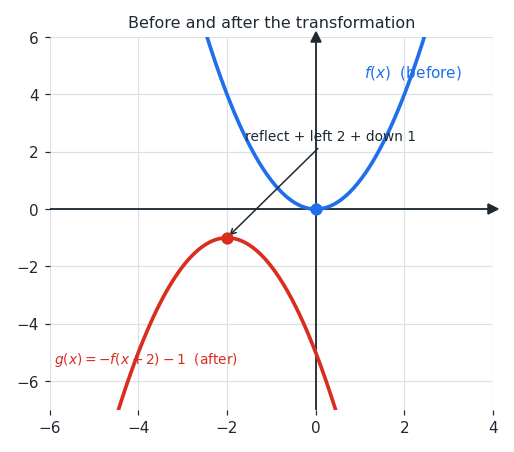
The graph below shows a function f(x) and its transformation g(x)=−f(x+2)−1. How does g transform f(x)? \ The +2 inside shifts f left 2, the minus sign flips it over the x-axis, and the −1 lowers it by 1. \ So g is f reflected over the x-axis, shifted left 2, and down 1.
Is this one of the topics costing you points?
Take the free 10-question diagnostic for a predicted SAT score and a breakdown of which domains are costing you points.