Basic coordinate geometry
An SAT micro-topic explainer. Free to read — no account needed.
Every point in the plane is located by an ordered pair . The first number is how far the point sits horizontally from the -axis, and the second is how far it sits vertically from the -axis.
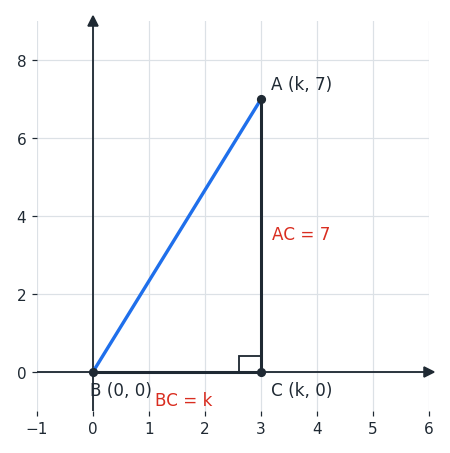
The figure shows why this is so useful. For point , drop a perpendicular to the -axis at . The vertical leg equals the -coordinate, , and the horizontal leg from the origin equals the -coordinate, . The right angle sits at , so a point and the origin form a right triangle whose legs you can read straight off the coordinates.
Moving points is just arithmetic on the coordinates. Shifting left by subtracts from ; shifting right adds . Shifting down subtracts from ; shifting up adds. For example, shifting the point left by gives .
Worked examples
Point sits in the plane, with the origin at . How far is from each axis? \ Its horizontal distance from the -axis is the -coordinate, . \ Its vertical distance from the -axis is the -coordinate, .
A circle has centre . If it is shifted units to the left, only the -coordinate changes: subtract to get the new centre .
Is this one of the topics costing you points?
Take the free 10-question diagnostic for a predicted SAT score and a breakdown of which domains are costing you points.