An SAT micro-topic explainer. Free to read — no account needed.
Fraction questions usually come down to two moves: taking a fraction of an amount, and finding what fraction one amount is of another.
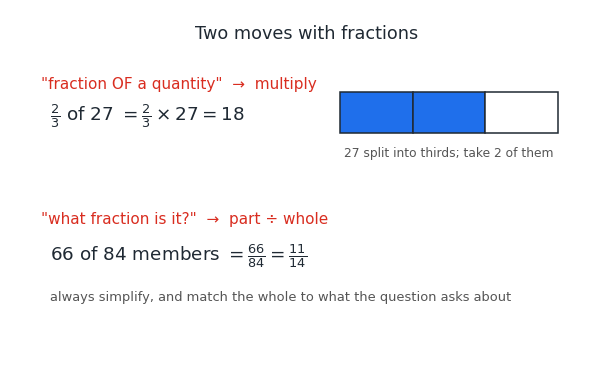
"A fraction of a quantity" always means multiply. To find 32 of 27, compute 32×27=18. It helps to read "of" as a multiplication sign every time it appears.
"What fraction is it?" means put the part over the whole, then simplify. If 66 of 84 members went, the fraction is 8466, which reduces to 1411. Always reduce the fraction to lowest terms at the end.
The most common slip is using the wrong whole in the denominator. "What fraction of the whole team" divides by the full team size, while "what fraction of those who stayed" divides only by the ones who stayed. Multi-step problems often ask you to first find the part — for instance adding two groups — and then divide by the correct total.
Worked examples
A garden is 40 units and 21 of it is weeded. How many units are weeded? "A fraction of a quantity" means multiply: 21×40. So 20 units are weeded.
Out of a team of 84 members, 66 ended up going to the competition. What fraction is that? Put the part over the whole: 8466. Dividing top and bottom by 6, this simplifies to 1411.
A field is 50 units in all, and 26 units are weeded. What fraction is NOT weeded? First find the un-weeded part: 50−26=24 units. Then the fraction is 5024=2512.
Is this one of the topics costing you points?
Take the free 10-question diagnostic for a predicted SAT score and a breakdown of which domains are costing you points.