An SAT micro-topic explainer. Free to read — no account needed.
A simple average treats every value equally. A weighted average is different: some values carry more weight because they represent a bigger share. For example, a test worth 2 grades should count twice as much as a quiz worth 1.
The formula multiplies each value by its weight, adds those up, and divides by the total weight: w1+w2w1v1+w2v2. The weights are the sizes or importance of each group, and the values are what you are averaging.
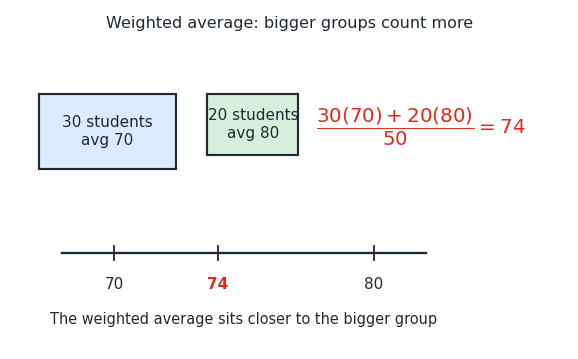
Here is a concrete case. One class of 30 students averages 70, and another of 20 students averages 80. The overall average is 30+2030(70)+20(80)=502100+1600=503700=74.
Notice the result, 74, is closer to 70 than to 80. That is because the 70 group is bigger, so it pulls the average toward itself. A weighted average always lands between the values, nearer to the heavier weight.
Worked examples
A student scores 90 on a test that counts as 2 grades and 60 on a quiz that counts as 1 grade. What is the weighted average? Multiply each score by its weight, add, and divide by the total weight: 2+12(90)+1(60). That is 3180+60=3240=80.
An investor puts $3000 in Fund A, which returns 5%, and $2000 in Fund B, which returns 10%. What is the overall percent return? Weight each return by the amount invested: 3000+20003000(5%)+2000(10%). That is 5000150+200=5000350=0.07=7%.
A store sold 40 items at $5 each and 10 items at $15 each. What was the average price per item? Weight each price by how many sold: 40+1040(5)+10(15). That is 50200+150=50350=7, so the average price is $7.
Is this one of the topics costing you points?
Take the free 10-question diagnostic for a predicted SAT score and a breakdown of which domains are costing you points.