Circle basics
An SAT Math micro-topic under Unit circle trigonometry (Geometry and trigonometry). Free to read — no account needed.
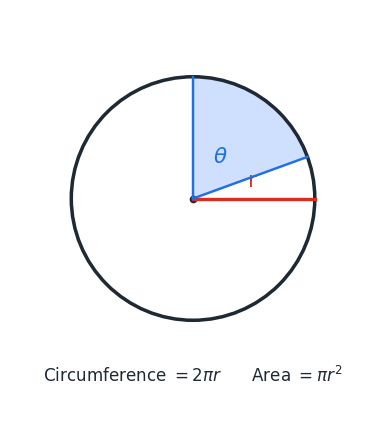
A circle is measured from its centre. The radius is the distance from the centre to the edge, and the diameter is twice that, . The distance all the way around the edge is the circumference, , and the space inside is the area, .
For example, a circle of radius has circumference and area .
A slice of a circle is a sector, and part of the edge is an arc. The central angle of a sector is a fraction of the full turn of , and the sector takes exactly that fraction of the whole circle.
For a central angle of , the fraction is , so the sector is a quarter of the area and the arc is a quarter of the circumference.
For a central angle of , the fraction is , so the sector is a quarter of the area and the arc is a quarter of the circumference.
In general, the sector area is and the arc length is .
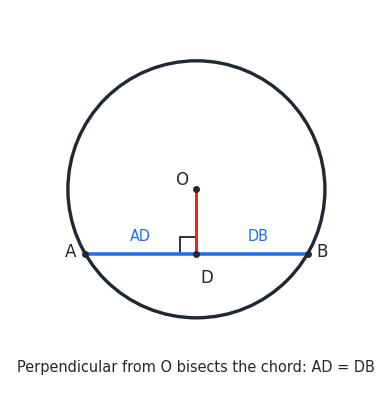
A useful fact about chords: if you draw a perpendicular from the centre of a circle to a chord, it cuts the chord exactly in half.
In the figure below, the perpendicular from meets the chord at , so .
In the figure below, the perpendicular from meets the chord at , so .
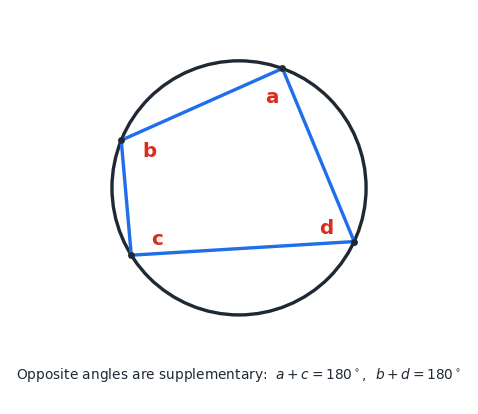
A quadrilateral whose four corners all lie on a circle is called a cyclic quadrilateral, and its opposite angles always add up to .
In the figure below, and .
In the figure below, and .
Worked examples
A circle has radius . What is its area?
Use :
.
Use :
.
A circle has radius . What is its circumference?
Use :
.
Use :
.
A sector has central angle in a circle of radius . What is its area?
The fraction of the circle is .
Sector area .
The fraction of the circle is .
Sector area .
In a circle of radius , an arc has central angle . What is its length?
The fraction is .
Arc length .
The fraction is .
Arc length .
A chord is long, and a perpendicular is drawn to it from the centre , meeting it at . What is ?
The perpendicular from the centre bisects the chord, so .
The perpendicular from the centre bisects the chord, so .
A cyclic quadrilateral has one angle of . What is the angle opposite it?
Opposite angles of a cyclic quadrilateral add to .
So the opposite angle is .
Opposite angles of a cyclic quadrilateral add to .
So the opposite angle is .
Is this one of the topics costing you points?
Take the free 10-question diagnostic for a predicted SAT score and a breakdown of which domains are costing you points.