An SAT micro-topic explainer. Free to read — no account needed.
Comparing whole numbers is easy, but fractions need a fair comparison. The cleanest way is to rewrite both fractions with the same denominator, then just compare the numerators.
For example, compare 52 and 2511. Rewrite 52 with denominator 25 by multiplying top and bottom by 5: 52=2510. Since 2511>2510, we get 2511>52.
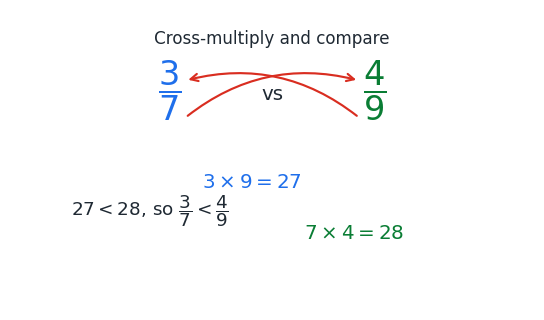
A faster shortcut is cross-multiplication. To compare ba and dc, compare a×d with b×c. Whichever product is bigger sits over the bigger fraction.
If you would rather not deal with fractions at all, convert each to a decimal. For instance, 52=0.40 and 2511=0.44. Comparing 0.40 and 0.44 shows 2511 is larger.
Worked examples
Which is greater, 43 or 75? Cross-multiply: for 43 and 75, compare 3×7=21 with 4×5=20. Since 21>20, the fraction 43 is greater.
Which is greater, 209 or 2511? Use a common denominator of 100: 209=10045 and 2511=10044. Since 45>44, the fraction 209 is greater.
Which is greater, 85 or 127? Convert to decimals: 85=0.625 and 127≈0.583. Since 0.625>0.583, the fraction 85 is greater.
Is this one of the topics costing you points?
Take the free 10-question diagnostic for a predicted SAT score and a breakdown of which domains are costing you points.