An SAT micro-topic explainer. Free to read — no account needed.
Completing the square is most useful for putting a quadratic into vertex form: a(x−h)2+k. In this form the vertex sits at (h,k), so it is the fastest way to find a parabola's turning point.
When the coefficient of x2 is 1, you just complete the square as usual. For example, x2+6x+5 becomes (x+3)2−9+5=(x+3)2−4, so its vertex is (−3,−4).
When the leading coefficient is not 1, factor it out of the x-terms first. Take 2x2+8x+1: factor 2 from the x-terms to get 2(x2+4x)+1.
Now complete the square inside the parentheses, then multiply the correction back out. Inside, x2+4x needs 4, so x2+4x=(x+2)2−4. Then 2[(x+2)2−4]+1=2(x+2)2−8+1=2(x+2)2−7.
Once it is in vertex form, just read off (h,k). Be careful with the sign: a(x−h)2+k means the x-coordinate is h, so 2(x+2)2−7 has its vertex at (−2,−7).
Worked examples
Write 2x2−4x−3 in vertex form. Factor 2 from the x-terms: 2(x2−2x)−3, and inside, x2−2x=(x−1)2−1. So 2[(x−1)2−1]−3=2(x−1)2−5.
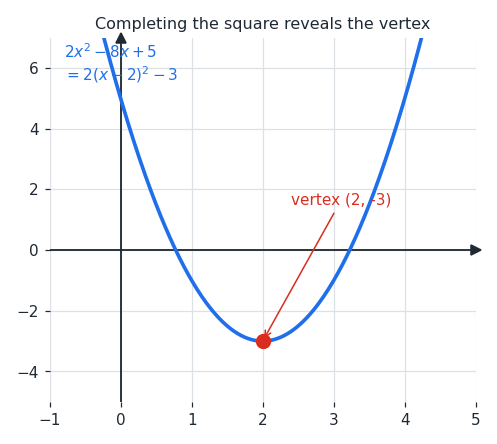
Find the vertex of f(x)=2x2−8x+5. Factor 2 from the x-terms: 2(x2−4x)+5, and inside, x2−4x=(x−2)2−4. So f(x)=2(x−2)2−3, and the vertex is at (2,−3).
Find the vertex of y=x2+10x+21. The leading coefficient is 1, so complete the square directly: half of 10 is 5, giving (x+5)2−25+21. So y=(x+5)2−4, and the vertex is at (−5,−4).
Is this one of the topics costing you points?
Take the free 10-question diagnostic for a predicted SAT score and a breakdown of which domains are costing you points.