An SAT micro-topic explainer. Free to read — no account needed.
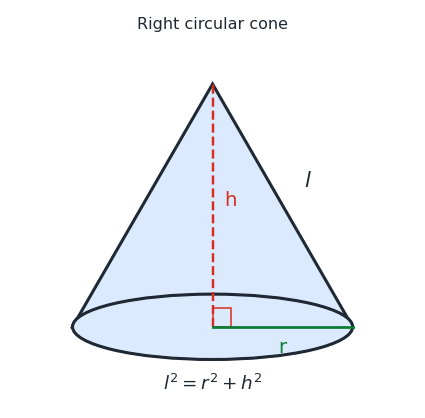
A right circular cone has a circular base and a single point (the apex) directly above the center. Three lengths describe it: the base radiusr, the vertical heighth from the center up to the apex, and the slant heightl along the side.
The radius, height, and slant height form a right triangle. The height and radius are the two legs, and the slant height is the hypotenuse, so l2=r2+h2. This lets you find any one of the three from the other two.
Two more formulas describe the size of a cone. The base is a circle, so its area is πr2. The volume is one-third of a cylinder with the same base and height: 31πr2h.
Many questions give you one measurement indirectly. For instance, a base area of 2304π means πr2=2304π, so r2=2304 and r=48. From there you can use l2=r2+h2 to find the height.
Worked examples
A cone has a radius of 3 and a vertical height of 4. What is its slant height? Use l2=r2+h2: l2=32+42=9+16=25. So l=25=5.
A cone has a radius of 48 and a slant height of 52. What is its vertical height? Rearrange l2=r2+h2 to h2=l2−r2=522−482=2704−2304=400. So h=400=20.
A cone has a radius of 6 and a height of 10. What is its volume? Use V=31πr2h with r=6 and h=10. So V=31π(36)(10)=120π.
Is this one of the topics costing you points?
Take the free 10-question diagnostic for a predicted SAT score and a breakdown of which domains are costing you points.