An SAT micro-topic explainer. Free to read — no account needed.
Counting the items in a range has a famous trap: the off-by-one error. It happens because you must decide whether the two endpoints are included in the count or not. Simply subtracting the endpoints often gives the wrong answer.
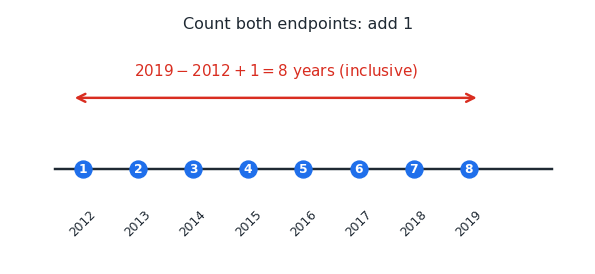
When both endpoints are included, the count is b−a+1. For example, the years from 2012 to 2019 inclusive number 2019−2012+1=8, not 7. You add the extra 1 to count the starting year itself.
This shows up in sequences, where the terms are numbered n=1,2,3,…. If a sequence starts in a given year at n=1, then the value at term n is start+(n−1). The (n−1) is the inclusive-counting idea again: the first term adds nothing.
A related question asks how many steps or events happen across a span. There you divide the length of the span by the size of each step. For instance, if something doubles every 5000 cycles from cycle 10,000 to cycle 25,000, it doubles 500025,000−10,000=3 times.
Worked examples
How many integers are there from 3 to 9, inclusive? Since both endpoints are included, use b−a+1. So it is 9−3+1=7 integers.
A sequence starts in 2015, which is term n=1. What year is term n=11? The year at term n is start+(n−1). So it is 2015+(11−1)=2025.
A quantity doubles every 5000 cycles, from cycle 10,000 to cycle 25,000. How many times does it double? Divide the span by the step size: 500025,000−10,000. So it doubles 500015,000=3 times.
Is this one of the topics costing you points?
Take the free 10-question diagnostic for a predicted SAT score and a breakdown of which domains are costing you points.