An SAT Reading & Writing micro-topic under Command of Evidence: Textual (Information and Ideas). Free to read — no account needed.
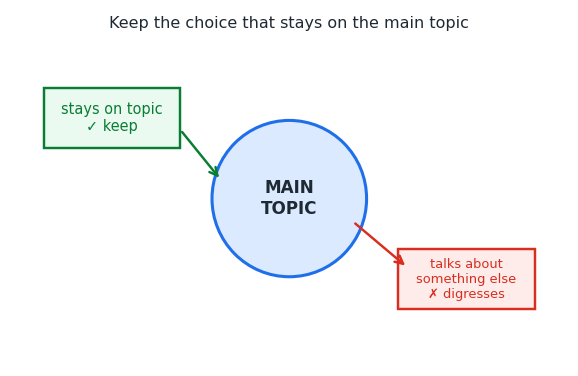
To digress means to drift off the passage's main topic onto something else. On these questions, some answer choices do exactly that: they sound reasonable but change the subject, so they are wrong. The clearest way to see it is with a few complete examples.
Honeybees face a daily challenge: finding flowers scattered across a wide landscape. Researchers have discovered that a foraging bee relies heavily on smell, following the faint scent of nectar carried on the breeze until it reaches a blossom. This chemical guidance lets a single bee locate hundreds of flowers in one trip. Choice A: "In experiments, bees whose sense of smell was blocked could no longer track nectar and struggled to find flowers at all." Choice B: "Many home gardeners plant brightly colored tulips and daffodils to make their yards more attractive in spring." Choice A stays on how bees use scent to find flowers, while Choice B drifts off to gardeners decorating their yards, so B digresses.
Along many tropical shorelines, coral reefs act as natural barriers against the sea. As powerful storm waves roll in from open water, they strike the rugged reef first, which absorbs and scatters much of their energy. By the time the water reaches the beach, its force has been greatly reduced, sparing the coastline from erosion. Choice A: "In places where the reefs have died off, scientists have recorded far more severe storm damage along the shore behind them." Choice B: "Coral reefs also shelter thousands of species of fish, making them among the most biologically diverse habitats on Earth." Choice A stays on the reef's role in protecting the coast, but Choice B shifts to the fish that live there — interesting, yet off the point — so B digresses.
A steel factory on the edge of town had long been criticized for the thick smoke pouring from its chimneys. Last year the company installed a new set of air filters designed to trap pollutants before they escape. Local officials wanted to know whether the filters had truly made the surrounding air cleaner. Choice A: "Air-quality sensors near the factory recorded a fifty percent drop in harmful particles in the months after the filters were installed." Choice B: "During that same period, the factory also bought new machinery that raised its daily steel output to record levels." Choice B still mentions the factory, so it looks relevant, but it shifts to production instead of air quality, so it digresses.
In every case, keep the choice that advances the main topic and cross out the one that changes the subject.
Worked examples
Archaeologists working at an ancient site have uncovered a remarkable series of wall murals. The paintings, still vivid after centuries, are crowded with figures — groups of people feasting, dancing, and taking part in ceremonies together. Researchers believe the murals were created to celebrate the shared, communal life of the community that made them. Which choice stays on the main topic and does NOT digress? (A) A newly cleaned section of a nearby mural clearly shows dozens of people joined in a single ritual dance. (B) The ancient city surrounding the site was admired for its wide, carefully planned avenues and grand stone temples. Choice (A) stays on the murals and the group scenes they depict, supporting the main point. Choice (B) drifts to the city's streets and architecture, so it digresses and is wrong.
Deep in the Egyptian desert, a team has discovered a tomb belonging to a pharaoh whose name appears in no known records. The burial chamber is packed with artifacts and covered in hieroglyphics describing the ruler's deeds. From these inscriptions, historians argue that this forgotten pharaoh once held powerful influence over Ancient Egypt's politics. Which choice stays on the main topic and does NOT digress? (A) The tomb's inscriptions describe the pharaoh issuing new laws and commanding governors across the kingdom. (B) Ancient Egypt is well known for its extensive trade networks with neighboring civilizations along the Nile. Choice (A) speaks directly to the pharaoh's political power, the main point. Choice (B) shifts to trade with neighbors and never even mentions the pharaoh, so it digresses.
Living in water with an extreme pH — either very acidic or very alkaline — is difficult for most organisms. Yet some marine species have evolved clever ways to cope with these harsh conditions. This passage focuses on the special adaptations that let such organisms keep their bodies working in chemically hostile water. Which choice stays on the main topic and does NOT digress? (A) Certain fish have specialized cells that pump out excess acid, keeping their internal pH stable even in acidic seawater. (B) Other deep-sea creatures have instead adapted to survive the crushing pressures found thousands of meters below the surface. Choice (A) stays on adapting to extreme pH, exactly the passage's subject. Choice (B) switches to surviving high pressure, a different kind of adaptation, so it digresses.
Is this one of the topics costing you points?
Take the free 10-question diagnostic for a predicted SAT score and a breakdown of which domains are costing you points.