An SAT micro-topic explainer. Free to read — no account needed.
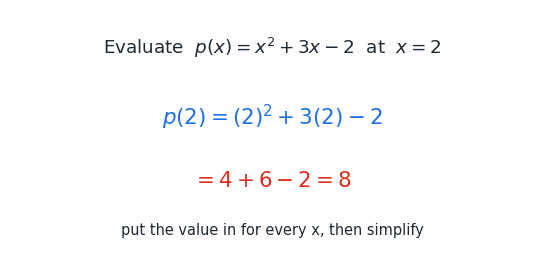
To evaluate a polynomial function at a number means to find the output for that input. You simply substitute the value in place of every x and simplify.
For example, to find p(2) for p(x)=x2+3x−2, replace each x with 2: (2)2+3(2)−2=4+6−2=8. Be careful to apply the power and multiplication before adding.
Often a question gives you the value of p at some point and asks you to find an unknown coefficient. You substitute the point in, set the result equal to the given value, and solve. This turns the function into an equation for the unknown.
Evaluating also connects to division through the remainder theorem. The remainder when p(x) is divided by (x−a) is exactly p(a). So instead of doing long division, you can just evaluate p(a).
Worked examples
For p(x)=2x2−x+3, what is p(2)? Substitute 2 for each x: 2(2)2−(2)+3. So p(2)=8−2+3=9.
Given p(x)=x3+kx2−4x+2 and p(1)=5, find k. Substitute x=1: 1+k−4+2=k−1. Setting k−1=5 gives k=6.
What is the remainder when p(x)=x3−2x+4 is divided by (x−2)? By the remainder theorem, the remainder is p(2). So it is (2)3−2(2)+4=8−4+4=8.
Is this one of the topics costing you points?
Take the free 10-question diagnostic for a predicted SAT score and a breakdown of which domains are costing you points.