expressing a quantity as a constant or coefficient
An SAT micro-topic explainer. Free to read — no account needed.
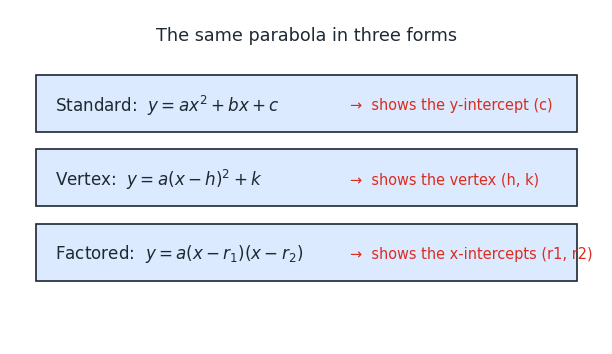
A quadratic can be written several equivalent ways, and each way makes a different quantity easy to read off. A quantity shown as a constant or coefficient is one that appears as a plain number in the expression, not something you have to compute.
Factored form, y=a(x−r1)(x−r2), shows the x-intercepts directly. The numbers r1 and r2 are exactly where the parabola crosses the x-axis. For example, y=(x−2)(x−5) shows its x-intercepts as 2 and 5.
Vertex form, y=a(x−h)2+k, shows the vertex directly. The vertex sits at (h,k), right there in the expression. For example, y=(x−1)2+4 shows its vertex as (1,4).
Standard form, y=ax2+bx+c, shows the y-intercept directly. The constant term c is the value when x=0, which is the y-intercept. So the last number in standard form is the y-intercept.
So the strategy is simple: decide which quantity the question wants displayed, then choose the matching form. The right answer is the equivalent form that shows that value as a plain constant or coefficient.
Worked examples
The parabola y=x2+6x−16 has x-intercepts at 2 and −8. Which equivalent form shows these intercepts directly? The factored form y=a(x−r1)(x−r2) puts the x-intercepts where you can read them off. So y=(x−2)(x+8) displays the intercepts 2 and −8.
Which form of a quadratic displays its vertex as constants? The vertex form y=a(x−h)2+k shows the vertex (h,k) directly. For example, y=(x+3)2−25 displays its vertex as (−3,−25).
Which form of y=2x2−8x+3 shows its y-intercept as a constant? The standard form ends in a constant term, which is the value at x=0. So y=2x2−8x+3 shows the y-intercept 3 directly.
Is this one of the topics costing you points?
Take the free 10-question diagnostic for a predicted SAT score and a breakdown of which domains are costing you points.