finding equation of a straight line
An SAT micro-topic explainer. Free to read — no account needed.
Every straight line can be written as , with slope and -intercept . To build the equation you need two things: the slope, and one point the line passes through.
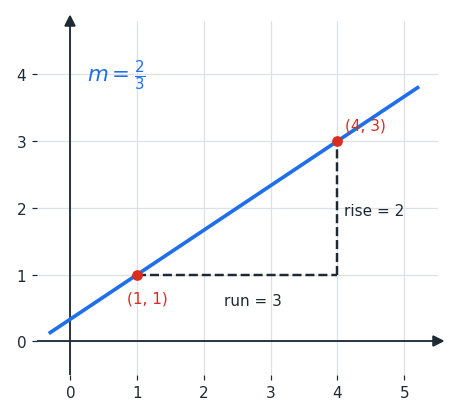
When you are given two points, the slope is the rise over the run: . In the figure, going from to the run is and the rise is , so the slope is .
Once you have the slope and any point, use point-slope form and simplify. With slope and point : , which gives .
Parallel lines have equal slopes; perpendicular lines have slopes that are negative reciprocals (they multiply to ). A line parallel to has slope , and one perpendicular to it has slope .
Worked examples
Find the equation of the line with slope passing through .
The point is the -intercept, so .
The equation is .
The point is the -intercept, so .
The equation is .
Find the equation of the line through and .
Slope .
The -intercept is (from ), so the equation is .
Slope .
The -intercept is (from ), so the equation is .
Find the line parallel to that passes through .
Rewrite as , so its slope is .
A parallel line has the same slope, and with -intercept : .
Rewrite as , so its slope is .
A parallel line has the same slope, and with -intercept : .
Is this one of the topics costing you points?
Take the free 10-question diagnostic for a predicted SAT score and a breakdown of which domains are costing you points.