An SAT micro-topic explainer. Free to read — no account needed.
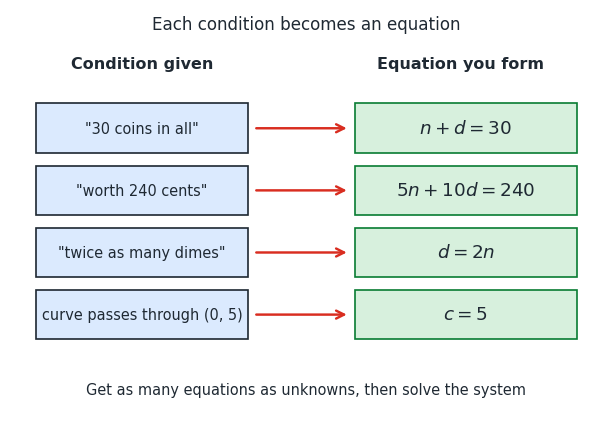
Here you are asked to find unknown values, but you are not handed a ready-made equation to solve. Instead you are given facts and relationships, and your job is to translate each one into an equation. Every condition you are given becomes one equation.
Counts and totals are a common source of equations. Suppose a jar holds 30 coins, all nickels and dimes, worth 240 cents. "There are 30 coins in all" becomes n+d=30, and "they are worth 240 cents" becomes 5n+10d=240.
Relationships between the unknowns are equations too. "There are twice as many dimes as nickels" becomes d=2n, and "the two amounts add to 40" becomes x+y=40. Any stated link between the unknowns can be written down as an equation.
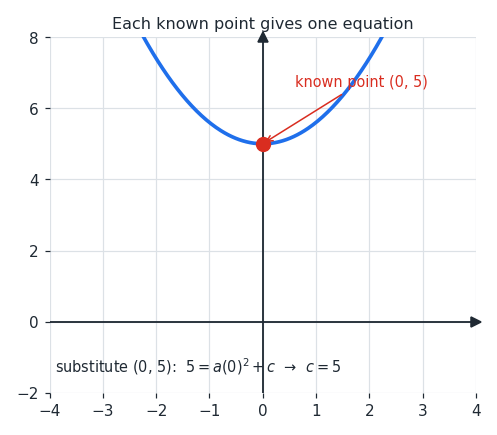
Features of a graph work the same way. A point the graph passes through, an intercept, or an asymptote is a condition you can substitute in to form an equation. For example, a curve through (0,5) gives 5=a(0)2+c, so c=5.
You need as many independent equations as there are unknowns. Two unknowns need two equations; three unknowns need three. Once you have enough, solve them together to find every value.
Worked examples
A theater sold 50 tickets for a total of $380. Adult tickets cost $10 and child tickets cost $6. Set up and solve a system to find how many of each. Let a be adult tickets and c be child tickets. The count gives a+c=50, and the money gives 10a+6c=380. From the first, a=50−c; substituting gives 10(50−c)+6c=380, so 500−4c=380 and c=30, a=20.
A test has 20 questions worth 100 points in total. Multiple-choice questions are worth 4 points each and essay questions 8 points each. Set up a system for the number of each. Let m be multiple-choice and e essay questions. The count gives m+e=20, and the points give 4m+8e=100. Substituting m=20−e gives 4(20−e)+8e=100, so 80+4e=100 and e=5, m=15.
The function y=a(2)x+c has a horizontal asymptote at 2 and a y-intercept at 1. Form equations and find a. The asymptote is a condition that gives c=2. The y-intercept is a condition at x=0, giving a(2)0+c=a+c=1. Substituting c=2 gives a+2=1, so a=−1.
Is this one of the topics costing you points?
Take the free 10-question diagnostic for a predicted SAT score and a breakdown of which domains are costing you points.