An SAT micro-topic explainer. Free to read — no account needed.
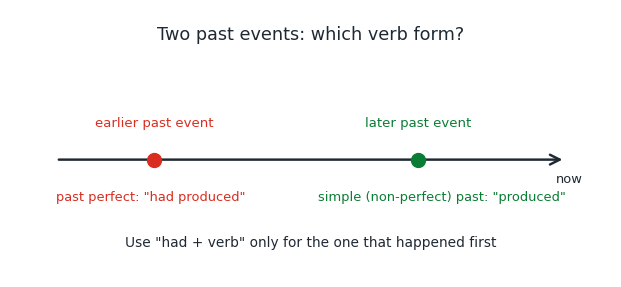
The past perfect ("had" + past participle, as in "had produced") marks the first of two past events. The plain simple past — a non-perfect form like "produced" — marks the later event.
So the order of events decides the verb form. "By the time the guests arrived, she had cooked dinner" uses the past perfect for the cooking, which came first, and the simple past for the arriving. The "had" form always points to the earlier action.
The trap is using the past perfect for the event that actually happened last. If a sentence first describes making measurements of the land and then drawing a map from them, the map-drawing is the later step, so it takes the simple past "produced", not "had produced". Putting "had" on the later event reverses the timeline and is wrong.
So first fix the order of the two past events, then match the forms. Give the earlier one the "had" form and the later one the plain past. You can also rule out present-tense choices right away when the surrounding clause is clearly in the past.
Worked examples
Which choice completes the sentence? "After he had gathered exact measurements of the terrain, he ______ a detailed map of the riverbank." (A) produced (B) had produced Gathering measurements came first and already uses "had gathered"; drawing the map is the later event. The later event takes the simple past, so (A), "produced", is correct.
Which choice completes the sentence? "By the time the museum opened its doors, the curator ______ every painting on the wall." (A) had hung (B) hangs The hanging happened before the opening, so it is the earlier of two past events. The earlier event takes the past perfect, so (A), "had hung", is correct.
Which choice completes the sentence? "The scientists had recorded the temperatures all winter, and in spring they ______ the results in a journal." (A) published (B) had published Recording came first and uses "had recorded"; publishing the results is the later step. The later event takes the simple past, so (A), "published", is correct.
Is this one of the topics costing you points?
Take the free 10-question diagnostic for a predicted SAT score and a breakdown of which domains are costing you points.