Identify patterns
An SAT micro-topic explainer. Free to read — no account needed.
A number pattern is usually arithmetic or geometric.
Arithmetic means each step adds the same fixed amount, called the common difference.
Geometric means each step multiplies by the same fixed number, called the common ratio.
Arithmetic means each step adds the same fixed amount, called the common difference.
Geometric means each step multiplies by the same fixed number, called the common ratio.
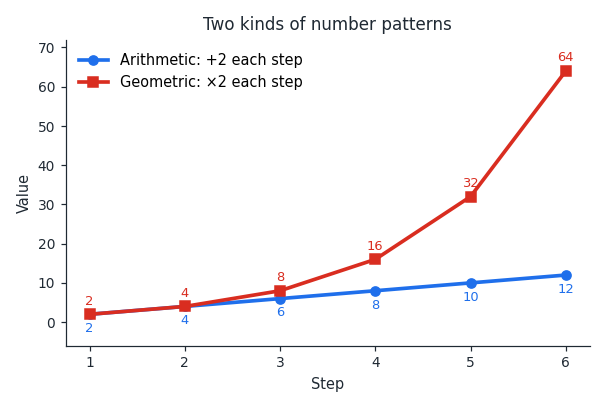
The graph shows the difference.
An arithmetic sequence grows by equal steps, so its points lie on a straight line.
A geometric sequence grows by multiplying, so it curves upward faster and faster.
An arithmetic sequence grows by equal steps, so its points lie on a straight line.
A geometric sequence grows by multiplying, so it curves upward faster and faster.
To tell which one a pattern is, look at consecutive terms.
Subtract each term from the next: if you always get the same amount, it is arithmetic.
Divide each term by the one before it: if you always get the same number, it is geometric.
Subtract each term from the next: if you always get the same amount, it is arithmetic.
Divide each term by the one before it: if you always get the same number, it is geometric.
These show up in word problems too.
"Increases by 50 units each month" is arithmetic, because it adds a fixed amount.
"Increases by 5% each month" is geometric, because a 5% rise means multiplying by 1.05 each time.
"Increases by 50 units each month" is arithmetic, because it adds a fixed amount.
"Increases by 5% each month" is geometric, because a 5% rise means multiplying by 1.05 each time.
Worked examples
Is the sequence 10, 13, 16, 19 arithmetic or geometric?
Check the differences: 13 - 10 = 3, 16 - 13 = 3, and 19 - 16 = 3.
The difference is always 3, so the sequence is arithmetic.
Check the differences: 13 - 10 = 3, 16 - 13 = 3, and 19 - 16 = 3.
The difference is always 3, so the sequence is arithmetic.
Is the sequence 2, 6, 18, 54 arithmetic or geometric?
Check the ratios: 6 / 2 = 3, 18 / 6 = 3, and 54 / 18 = 3.
The ratio is always 3, so the sequence is geometric.
Check the ratios: 6 / 2 = 3, 18 / 6 = 3, and 54 / 18 = 3.
The ratio is always 3, so the sequence is geometric.
One runner trains 10 hours the first week and adds 1.5 hours each week; another starts at 10 hours and increases by 8% each week. Which sequence does each follow?
Adding a fixed 1.5 hours is a constant difference, so the first runner's plan is arithmetic.
Increasing by 8% multiplies by a fixed 1.08, so the second runner's plan is geometric.
Adding a fixed 1.5 hours is a constant difference, so the first runner's plan is arithmetic.
Increasing by 8% multiplies by a fixed 1.08, so the second runner's plan is geometric.
Is this one of the topics costing you points?
Take the free 10-question diagnostic for a predicted SAT score and a breakdown of which domains are costing you points.