An SAT micro-topic explainer. Free to read — no account needed.
Some questions pin down a variable only indirectly, through constraints such as "odd", "distinct", "positive integers", an ordering like a<b, or a stated mean or median. The skill is to turn each constraint into a bound and then choose values at the extremes.
Take a simple one: 2a+1<10, where a must be an odd number. What is the largest possible value of a? Solving the inequality, 2a<9, so a<4.5. The odd numbers below 4.5 are 1 and 3, so the largest possible value is a=3.
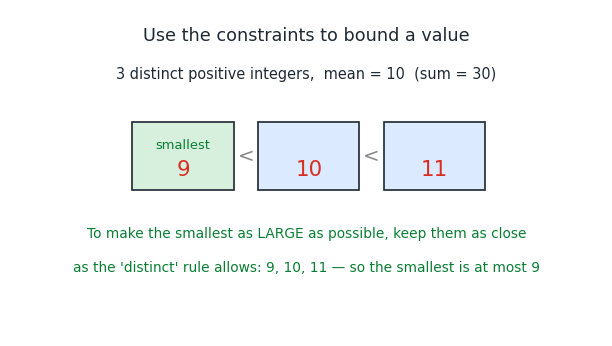
Now a mean-and-median example: three distinct positive integers have a mean of 10, so they add up to 30. What is the largest possible value of the smallest of them? To keep the smallest as large as possible, bunch the three as close together as "distinct" allows: s, s+1, s+2. Then s+(s+1)+(s+2)=30 gives 3s+3=30, so s=9, and the integers are 9,10,11.
So the recipe is always the same: translate each constraint into a limit, then to make one quantity extreme, push the others as far as the rules allow. To maximize one value, make the others as small as possible; to minimize it, make the others as large as possible. The "distinct", "integer", and ordering conditions decide exactly how far you can push.
Worked examples
In 3b−2<20, where b is an even number, what is the largest possible value of b? Solving, 3b<22, so b<322≈7.33. The largest even number below 7.33 is b=6.
Three distinct positive integers have a sum of 24. What is the largest possible value of the smallest of them? To keep the smallest as large as possible, make the three as close as "distinct" allows: s, s+1, s+2, summing to 24. Then 3s+3=24, so s=7, and the integers are 7,8,9.
Two positive integers a and b satisfy a<b and a+b=9. What is the smallest possible value of b? To make b small, make a as large as possible while keeping a<b. Since a and b are integers with a<b and a+b=9, the largest a can be is 4 (giving b=5); any larger a would break a<b, so the smallest possible b is 5.
Is this one of the topics costing you points?
Take the free 10-question diagnostic for a predicted SAT score and a breakdown of which domains are costing you points.