An SAT micro-topic explainer. Free to read — no account needed.
The range measures how spread out a data set is, from lowest to highest. It is simply the maximum value minus the minimum value.
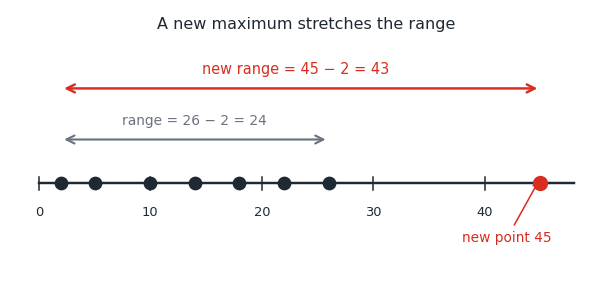
Because only the two extremes matter, a new data point changes the range only when it sits outside them. If a set runs from 2 to 26, its range is 26−2=24; adding a value of 45 makes 45 the new maximum, so the range grows to 45−2=43.
A new value that lands between the current minimum and maximum has no effect on the range. Adding 15 to that same set does not change the highest or lowest value, so the range stays 24.
Removing a data point can also change the range, but only if you remove one of the extremes. Taking out the maximum lowers the highest value, so the range shrinks; removing a middle value leaves the range the same.
Worked examples
A data set has a minimum of 5 and a maximum of 30. A new value of 50 is added. What is the new range? \ Since 50 is larger than the old maximum, it becomes the new maximum. \ So the range is 50−5=45.
A data set ranges from 10 to 40, and a new value of 25 is added. What happens to the range? The value 25 falls between the current minimum 10 and maximum 40, so it changes neither extreme. So the range stays 40−10=30.
A data set is 5,8,12,19,30. The value 30 is removed. What is the new range? Removing 30, the maximum, leaves 19 as the new highest value. So the new range is 19−5=14.
Is this one of the topics costing you points?
Take the free 10-question diagnostic for a predicted SAT score and a breakdown of which domains are costing you points.