An SAT micro-topic explainer. Free to read — no account needed.
When you take the reciprocal of both sides of an inequality, whether the sign flips depends on the signs of the two sides. This is different from ordinary algebra, so it needs care.
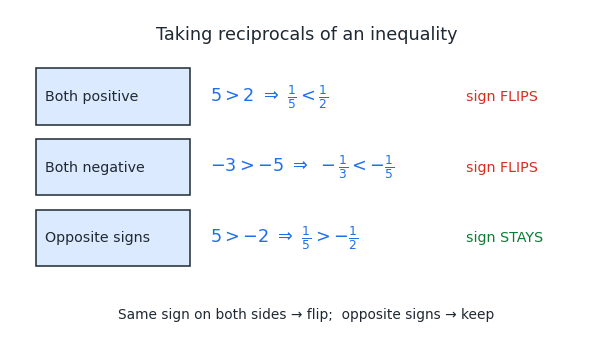
If both sides are positive, the reciprocal flips the inequality. Since 5>2, taking reciprocals gives 51<21, because a bigger positive number has a smaller reciprocal. The larger value becomes the smaller fraction.
If both sides are negative, the sign also flips. From −3>−5, the reciprocals are −31 and −51, and −31<−51. So among two negatives, taking reciprocals again reverses the order.
But if the sides have opposite signs, the inequality stays the same. From 5>−2, the reciprocals are 51 and −21, and a positive is still greater than a negative, so 51>−21. The rule: flip when both sides share a sign, keep when they do not.
Worked examples
Given 4>3, both positive, what happens to the reciprocals? With both sides positive, taking reciprocals flips the sign: 41<31. So the inequality reverses.
Given −2>−7, both negative, compare the reciprocals. Both sides are negative, so the sign flips: −21 and −71 give −21<−71. So the inequality reverses.
Given 6>−1, opposite signs, compare the reciprocals. The sides have opposite signs, so the inequality stays: 61 is positive and −1 has reciprocal −1. Since a positive exceeds a negative, 61>−1, unchanged.
Is this one of the topics costing you points?
Take the free 10-question diagnostic for a predicted SAT score and a breakdown of which domains are costing you points.