An SAT micro-topic explainer. Free to read — no account needed.
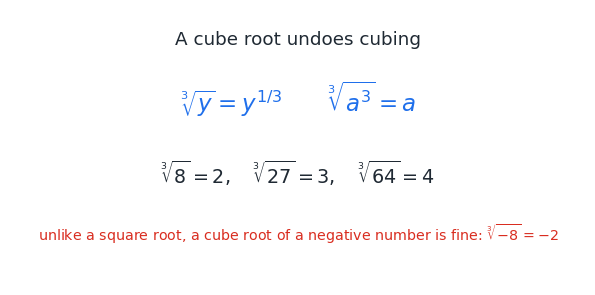
The cube root of y, written 3y or y1/3, is the number that gives y when cubed. Since 23=8, 38=2; since 33=27, 327=3.
A cube root undoes cubing, so 3a3=a. This makes it the natural tool when a variable appears cubed. If r3=8000, then r=38000, and since 8000=8×1000=23×103, r=2×10=20.
Cube roots behave well with negative numbers, unlike square roots. Because a negative number cubed is negative, 3−8=−2. So 3y is defined for every real y, positive or negative.
They also connect to solving power equations. If cmn=125 and m,n are integers, then c=5 because 53=125, so mn=3. Recognising a perfect cube like 125=53 turns the equation into a simple comparison of exponents.
Worked examples
What is 364? Ask what number cubed gives 64; since 43=64, the cube root is 4. So 364=4.
Solve m3=1000. Take the cube root of both sides: m=31000, and 1000=103. So m=10.
Evaluate 3−27. A cube root of a negative number is negative, and (−3)3=−27. So 3−27=−3.
Is this one of the topics costing you points?
Take the free 10-question diagnostic for a predicted SAT score and a breakdown of which domains are costing you points.