An SAT micro-topic explainer. Free to read — no account needed.
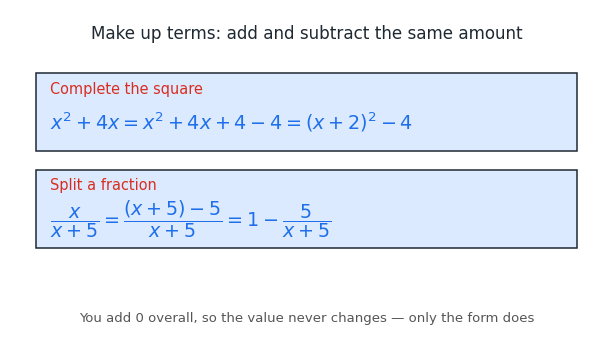
A powerful algebra move is to make up terms: add and subtract the same quantity, or split a term into two, so the expression keeps its value but takes a form you can actually work with. Because you add and subtract the same amount, you are really adding 0, so nothing changes.
One use is completing the square. To reshape x2+4x, make up the terms +4 and −4: x2+4x+4−4. The first three terms form a perfect square, so this becomes (x+2)2−4, which is far easier to graph or solve.
Another use is splitting a fraction. To simplify x+5x, rewrite the top x as (x+5)−5: x+5(x+5)−5. Splitting the fraction gives 1−x+55, a form that makes the behaviour and the asymptote obvious.
So decide what form you want — a perfect square, or a proper split — then work out the term you need and add it and subtract it together. Making up a term is legal precisely because the added and subtracted parts cancel. It turns an awkward expression into one you can graph, simplify, or solve.
Worked examples
Rewrite x2+6x by completing the square. Make up +9 and −9: x2+6x+9−9. The first three terms are a perfect square, so this is (x+3)2−9.
Rewrite x+3x+1 so the numerator has no x. Write the top x+1 as (x+3)−2: x+3(x+3)−2. Splitting the fraction gives 1−x+32.
Rewrite x−12x as a whole number plus a fraction. Write the top 2x as 2(x−1)+2: x−12(x−1)+2. Splitting the fraction gives 2+x−12.
Is this one of the topics costing you points?
Take the free 10-question diagnostic for a predicted SAT score and a breakdown of which domains are costing you points.