An SAT micro-topic explainer. Free to read — no account needed.
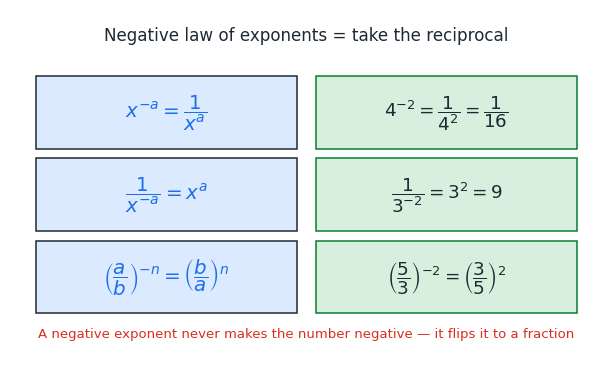
The negative law of exponents says x−a=xa1 for any nonzero x. A negative exponent is an instruction to take the reciprocal, not to make the number negative.
So a negative power moves the base to the denominator. 4−2=421=161, and 3−1=31. The result is a positive fraction, since the sign of the base is untouched.
The rule also runs in reverse: x−a1=xa. A base with a negative exponent sitting in a denominator moves up to the top with a positive exponent. So 3−21=32=9, and (2x)−21=(2x)2.
For a fraction raised to a negative power, flip the fraction. Since (ba)−n=(ab)n, we get (35)−2=(53)2. This is handy for exponential expressions: (32)−x=(23)x.
Worked examples
Evaluate 2−3. A negative exponent takes the reciprocal: 2−3=231. So it is 81.
Simplify 5−21. A negative exponent in the denominator moves up top: 5−21=52. So it is 25.
Rewrite (43)−2 without a negative exponent. Flip the fraction and drop the negative: (43)−2=(34)2. So it is 916.
Is this one of the topics costing you points?
Take the free 10-question diagnostic for a predicted SAT score and a breakdown of which domains are costing you points.