An SAT micro-topic explainer. Free to read — no account needed.
Many questions turn on the basic properties of numbers rather than on heavy computation. The key tools are parity (even or odd), prime numbers, and factors, applied under the constraints the problem gives.
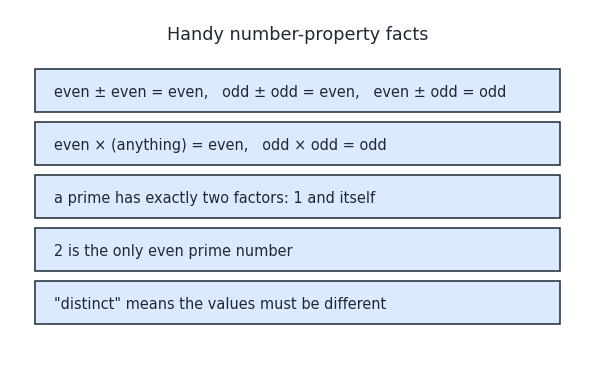
Parity rules are quick to use. Even plus even is even, odd plus odd is even, and even plus odd is odd. Also, an even number times anything is even, while odd times odd is odd.
Primes have exactly two factors: 1 and the number itself. So if something must divide a prime m, it can only be 1 or m. Remember that 2 is the only even prime.
When a problem adds constraints like "distinct" or "positive integers", test the possibilities one by one. For example, suppose a and b are distinct positive integers with a+b=5. Testing pairs, a=1,b=4 works and a=2,b=3 works, but a=0,b=5 fails because 0 is not positive, and a=b would break the "distinct" rule. Try each candidate, keep the ones that satisfy every condition, and rule out the rest.
Worked examples
If a and b are distinct positive integers with a+2b=6, what are the possible values of b? Test each: if b=1, then a=4 (distinct positive ✓); if b=2, then a=2 (not distinct ✗); if b=3, then a=0 (not positive ✗). So the only value is b=1.
Is the product of two consecutive integers always even? Of any two consecutive integers, one is even and one is odd. Since even times anything is even, the product is always even.
If (k−1) is a factor of a prime number m, and k is an integer greater than 1 with k−1=m, what is k? A prime's only factors are 1 and itself, so k−1 is 1 or m; since k−1=m, we need k−1=1. So k=2.
Is this one of the topics costing you points?
Take the free 10-question diagnostic for a predicted SAT score and a breakdown of which domains are costing you points.