An SAT micro-topic explainer. Free to read — no account needed.
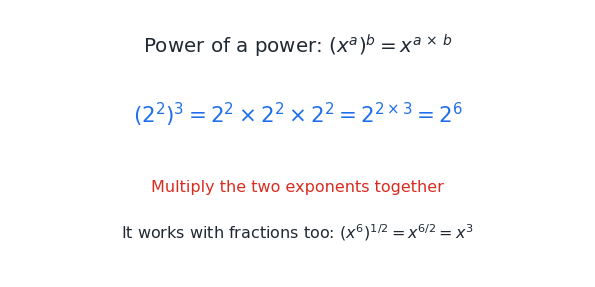
The power of a power rule says (xa)b=xa×b. It makes sense because (xa)b means multiplying xa by itself b times, which stacks up a×b copies of x.
So you just multiply the two exponents. For example, (32)4=32×4=38. There is no need to expand everything out.
The rule also covers fractional exponents, and a fraction stands for a root. Since 21 means a square root, (x6)21=x6×21=x3. A cube root would be a power of 31, and so on.
A useful trick is to rewrite the base as a power of a smaller prime. Since 8=23, you can write 8n=(23)n=23n. Turning everything into the same base lets you compare or simplify exponents easily.
Worked examples
Simplify (32)4. Multiply the exponents: (32)4=32×4. So it is 38.
Write (328)21 as a power of 2. First, (328)21=328×21=324. Then since 32=25, 324=(25)4=220.
Express 8n as a power of 2. Rewrite the base: 8=23, so 8n=(23)n. By the power-of-a-power rule, that is 23n.
Is this one of the topics costing you points?
Take the free 10-question diagnostic for a predicted SAT score and a breakdown of which domains are costing you points.