An SAT micro-topic explainer. Free to read — no account needed.
Prime factorisation means writing a whole number as a product of prime numbers — numbers whose only factors are 1 and themselves. Every whole number greater than 1 has exactly one such prime breakdown.
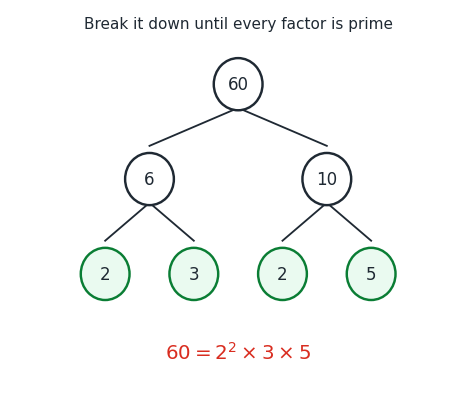
The easiest method is a factor tree. Split the number into any two factors, then keep splitting each factor until you are left only with primes.
Once you reach the primes, group the repeats using exponents. For example, breaking down 80 gives 2,2,2,2, and 5, which you write as 80=24×5. Writing it this way is compact and easy to work with.
Prime factorisation is the key to many number questions. Once you have the primes, you can list every factor, check divisibility, or find a greatest common factor. For instance, 930=2×3×5×31, so any product of those primes is a factor of 930.
Worked examples
What is the prime factorisation of 72? Break it down: 72=8×9=(2×2×2)×(3×3). Grouping the repeats, 72=23×32.
What is the prime factorisation of 5400? Break it down: 5400=54×100=(2×27)×(4×25)=2×33×22×52. Grouping the repeats, 5400=23×33×52.
Given that 84=22×3×7, is 21 a factor of 84? Since 21=3×7, and both 3 and 7 appear in the prime factorisation of 84, their product 21 divides it. So yes, 21 is a factor of 84.
Is this one of the topics costing you points?
Take the free 10-question diagnostic for a predicted SAT score and a breakdown of which domains are costing you points.