Prism basics
An SAT micro-topic explainer. Free to read — no account needed.
A rectangular prism is a box, and it has six rectangular faces in three matching pairs.
Its volume fills the inside, and its surface area covers the outside.
Its volume fills the inside, and its surface area covers the outside.
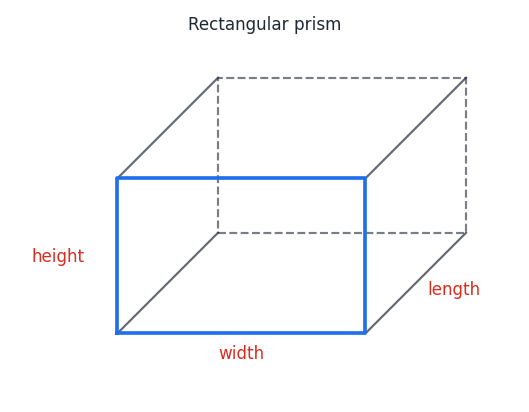
The figure shows a prism with its length, width, and height labeled.
The volume is .
The surface area is , since opposite faces have equal area.
The volume is .
The surface area is , since opposite faces have equal area.
For a square base of side and height , group the faces.
There are square bases, each , and rectangular sides, each .
So the surface area is .
There are square bases, each , and rectangular sides, each .
So the surface area is .
You can set surface area or volume equal to a given value to solve for .
If , then , so .
The volume is then .
If , then , so .
The volume is then .
Worked examples
A box has length , width , and height . What is its volume?
Volume is length times width times height: .
So the volume is .
Volume is length times width times height: .
So the volume is .
A prism has a square base of side and height . What is its surface area?
Two square bases give , and four side faces give .
So the surface area is .
Two square bases give , and four side faces give .
So the surface area is .
A prism with square base side and height has surface area . Find its volume.
Set , so and .
The volume is .
Set , so and .
The volume is .
Is this one of the topics costing you points?
Take the free 10-question diagnostic for a predicted SAT score and a breakdown of which domains are costing you points.