An SAT micro-topic explainer. Free to read — no account needed.
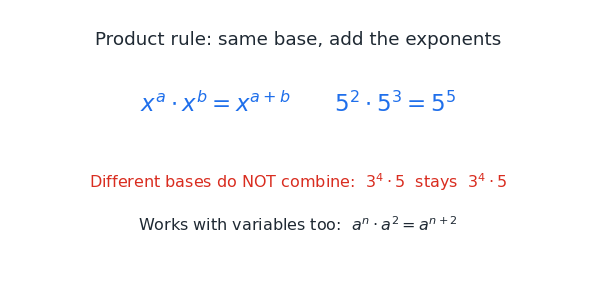
The product rule of exponents states that xa×xb=xa+b. It works because xa means a copies of x multiplied together and xb means b more, giving a+b copies in total.
So when the base is the same, you just add the exponents. For 52×53, the base is 5, so the result is 52+3=55. There is no need to work out the actual numbers first.
The rule applies only when the bases match. In 34×5, the bases 3 and 5 are different, so the expression cannot be simplified and stays as 34×5. You can only add exponents that sit on the same base.
The same idea works with variables and with negative exponents. To isolate y in x2y=x3, multiply both sides by x2, giving y=x3×x2=x5. And a symbolic power like an+2 can be split apart as an×a2 whenever that is convenient.
Worked examples
Simplify 23×24. The base is 2 on both, so add the exponents: 23+4. That is 27.
Solve for y: x2y=x3. Multiply both sides by x2: y=x3×x2. Adding the exponents, y=x5.
Can 72×4 be simplified using the product rule? The bases 7 and 4 are different, so their exponents cannot be added. So it stays as 72×4, which is 49×4=196.
Is this one of the topics costing you points?
Take the free 10-question diagnostic for a predicted SAT score and a breakdown of which domains are costing you points.