An SAT Reading & Writing micro-topic under Boundaries (Expression of Ideas + Standard English Conventions). Free to read — no account needed.
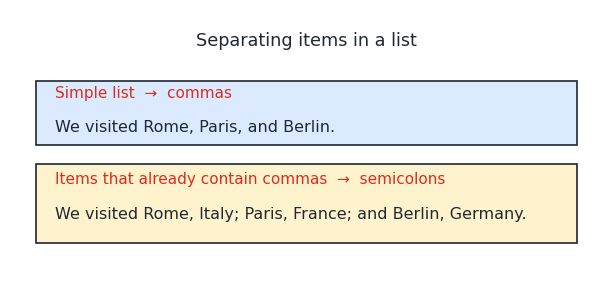
A plain list of items is separated by commas. "The recipe calls for flour, sugar, and eggs" uses a comma between each item.
When the items themselves contain commas, commas alone become confusing, so use semicolons between the items. "We visited Rome, Italy; Paris, France; and Berlin, Germany" keeps each city-and-country pair clearly separate. The semicolons mark the big divisions, and the commas stay inside each item.
A list can also be tucked into a sentence as extra information. When it is, set it off with matching punctuation at both ends — a comma before and a comma after, or a dash before and a dash after. The mark you start with must be the mark you finish with.
Worked examples
Which choice correctly punctuates the list? "The finalists were Ana, from Spain ______ Ravi, from India; and Mei, from China." (A) a comma (B) a semicolon Each item already contains a comma (the person and their country), so the items must be separated by semicolons. So (B), a semicolon, is correct.
Which choice correctly punctuates the list? "For the hike, bring a jacket ______ a map, and some water." (A) a comma (B) a semicolon This is a simple list whose items contain no commas of their own, so plain commas separate them. So (A), a comma, is correct.
Which choice correctly punctuates the sentence? "Many great writers ______ such as Tolstoy and Dickens, have crossed national borders." (A) a comma (B) a dash The phrase "such as Tolstoy and Dickens" ends with a comma, so it must also begin with a comma to match. So (A), a comma, is correct.
Is this one of the topics costing you points?
Take the free 10-question diagnostic for a predicted SAT score and a breakdown of which domains are costing you points.