An SAT micro-topic explainer. Free to read — no account needed.
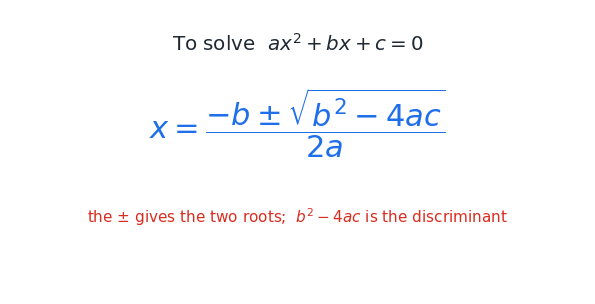
When a quadratic will not factor easily, the quadratic formula always works. For any equation ax2+bx+c=0, the solutions are x=2a−b±b2−4ac.
To use it, first identify a, b, and c from the equation. Then substitute those numbers into the formula and simplify carefully, watching the signs.
The ± sign is what gives a quadratic its two roots — one using + and one using −. The part under the root, b2−4ac, is called the discriminant; if it is negative, there are no real solutions.
So if you know one root has the form 2a−b+D, the other must be 2a−b−D. The two roots differ only in that ± sign.
Worked examples
Solve 3x2+2x−4=0 using the quadratic formula. Here a=3, b=2, c=−4, so x=2(3)−2±22−4(3)(−4). That is x=6−2±4+48=6−2±52.
Solve x2−5x+6=0 using the quadratic formula. Here a=1, b=−5, c=6, so x=25±25−24=25±1. So x=3 or x=2.
A quadratic has one root equal to 2a−b+D. What is the other root? The two roots differ only in the ± sign in the formula. So the other root is 2a−b−D.
Is this one of the topics costing you points?
Take the free 10-question diagnostic for a predicted SAT score and a breakdown of which domains are costing you points.