Radicals and rational exponents
An SAT micro-topic explainer. Free to read — no account needed.
Radicals and exponents are two ways of writing the same thing.
A root becomes a fractional exponent: , , and in general .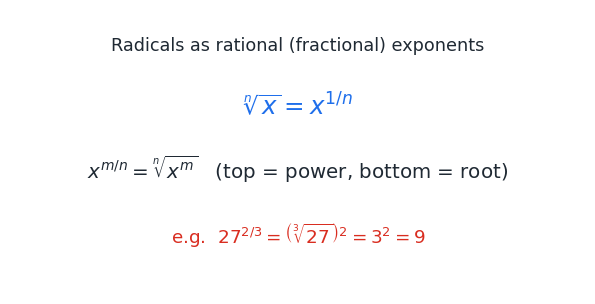
A root becomes a fractional exponent: , , and in general .
When the exponent is a fraction , the bottom is the root and the top is the power: .
You can also take the root first: .
You can also take the root first: .
Switching to whichever form is easier often simplifies the work.
To evaluate , take the cube root first: , then square it to get .
To evaluate , take the cube root first: , then square it to get .
A negative rational exponent means take the reciprocal.
For example, .
For example, .
Worked examples
Write as a power of .
The bottom of the exponent is the root () and the top is the power ().
So .
The bottom of the exponent is the root () and the top is the power ().
So .
Evaluate .
Take the fourth root first: , then raise it to the third power.
So .
Take the fourth root first: , then raise it to the third power.
So .
Write as a radical in simplest form.
The bottom is a square root and the top is the power: .
Since , this simplifies to .
The bottom is a square root and the top is the power: .
Since , this simplifies to .
Is this one of the topics costing you points?
Take the free 10-question diagnostic for a predicted SAT score and a breakdown of which domains are costing you points.