Reflecting functions
An SAT micro-topic explainer. Free to read — no account needed.
A reflection across the -axis mirrors a graph from left to right.
You form it by replacing with , giving .
Each point moves to , keeping the same height.
You form it by replacing with , giving .
Each point moves to , keeping the same height.
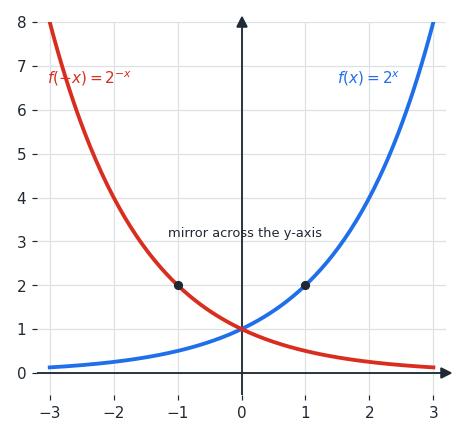
The figure shows a function and its reflection across the -axis.
Each point swaps to the opposite side while keeping its height.
The -axis acts like a mirror between the two curves.
Each point swaps to the opposite side while keeping its height.
The -axis acts like a mirror between the two curves.
Two functions are symmetric about the -axis when one is the other with replaced by .
In symbols, .
So if , its mirror image is .
In symbols, .
So if , its mirror image is .
This is different from reflecting across the -axis.
A -axis reflection changes the input, , flipping the graph left-right.
An -axis reflection changes the output, , flipping the graph up-down.
A -axis reflection changes the input, , flipping the graph left-right.
An -axis reflection changes the output, , flipping the graph up-down.
Worked examples
Reflect across the -axis. What is the new function?
Replace with : .
So the reflection is .
Replace with : .
So the reflection is .
A point lies on a graph. Where does it go when the graph is reflected across the -axis?
A -axis reflection sends to .
So moves to .
A -axis reflection sends to .
So moves to .
If and is its reflection across the -axis, what is ?
Symmetry about the -axis means , so .
Replacing with gives .
Symmetry about the -axis means , so .
Replacing with gives .
Is this one of the topics costing you points?
Take the free 10-question diagnostic for a predicted SAT score and a breakdown of which domains are costing you points.