An SAT micro-topic explainer. Free to read — no account needed.
In a rhetorical synthesis question, a student has gathered 4 to 6 bullet-point notes on a topic, and the question states a goal for how to use them. You then choose the sentence that best meets that goal, drawing on the relevant notes.
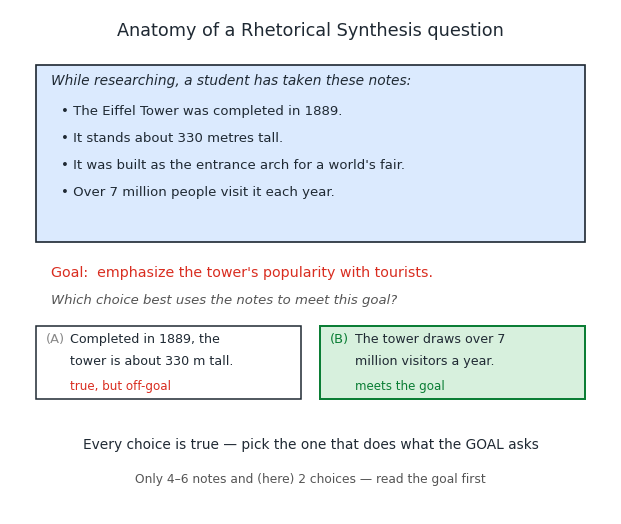
Here is the shape of a full question. The student's notes are a short list of bullet points: - The Eiffel Tower was completed in 1889. - It stands about 330 metres tall. - It was built as the entrance arch for a world's fair. - Over 7 million people visit it each year. Goal: emphasize the tower's popularity with tourists.
Now weigh the choices against that goal. A choice like "Completed in 1889, the tower is about 330 metres tall" is perfectly true, but it says nothing about popularity, so it is off-goal. The choice "The tower draws over 7 million visitors a year" uses the note that directly speaks to popularity, so it meets the goal.
So the method is always the same: read the goal first, then test each choice against it. Ask not "is this true?" — they usually all are — but "does this do the specific job the goal describes?" The most common wrong answer is a true statement that answers a different goal than the one asked.
Worked examples
While researching renewable energy, a student has taken the following notes: - Solar panel prices fell by about 80% between 2010 and 2020. - By 2020, solar was the cheapest source of electricity in many countries. - Solar farms can be built in only a few months. - Some solar farms now supply power to entire towns. The student wants to emphasize how affordable solar power has become. Which choice most effectively uses relevant information from the notes to accomplish this goal? (A) Solar farms can be built in only a few months and now power entire towns. (B) Solar panel prices fell by about 80% from 2010 to 2020, making solar the cheapest electricity source in many countries. The goal is to emphasize affordability, so the right choice must focus on cost. Choice (A) describes speed and capacity, not price, while (B) highlights the falling cost directly, so (B) accomplishes the goal.
While studying two ancient towns, a student has taken the following notes: - Pompeii was buried by a volcanic eruption in 79 CE. - Its streets and buildings were preserved almost intact under volcanic ash. - Herculaneum, a nearby town, was also buried in 79 CE. - Herculaneum was covered by mud, which preserved wooden objects and even food. The student wants to emphasize a difference in how the two towns were preserved. Which choice most effectively accomplishes this goal? (A) Both Pompeii and Herculaneum were buried in the same eruption in 79 CE. (B) Pompeii was preserved under volcanic ash, whereas Herculaneum was preserved under mud that saved even wood and food. The goal is to emphasize a difference, so the choice must contrast the two towns. Choice (A) states only what they share, while (B) sets ash against mud, so (B) accomplishes the goal.
While researching a scientist, a student has taken the following notes: - Katherine Johnson was a mathematician who worked at NASA. - She calculated flight paths for early US space missions. - Her calculations helped bring the Apollo 11 astronauts safely back to Earth. - She received the Presidential Medal of Freedom in 2015. The student wants to introduce Katherine Johnson to an audience unfamiliar with her. Which choice most effectively accomplishes this goal? (A) In 2015, Katherine Johnson received the Presidential Medal of Freedom. (B) Katherine Johnson was a NASA mathematician whose calculations guided early US space missions. To introduce someone to an unfamiliar audience, the choice should say who she was and what she did. Choice (A) names an award without context, while (B) identifies her role and contribution, so (B) accomplishes the goal.
Is this one of the topics costing you points?
Take the free 10-question diagnostic for a predicted SAT score and a breakdown of which domains are costing you points.