Rotation of points in unit circle trigonometry
An SAT micro-topic explainer. Free to read — no account needed.
A rotation of a unit-circle point follows a fixed coordinate rule.
Rotating by gives , a reflection through the center.
Rotating by counterclockwise gives .
Rotating by gives , a reflection through the center.
Rotating by counterclockwise gives .
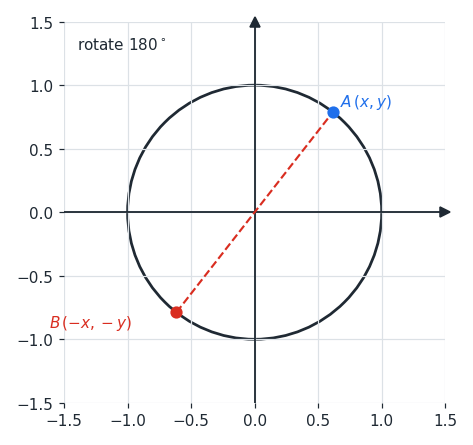
The figure shows a point and its rotation .
The two points are diametrically opposite, connected by a line through the center.
Each coordinate of becomes its negative in .
The two points are diametrically opposite, connected by a line through the center.
Each coordinate of becomes its negative in .
Rotating by is the same as adding to the angle.
So the point at angle is the rotation of the point at .
If gives , then gives .
So the point at angle is the rotation of the point at .
If gives , then gives .
The new quadrant tells you the signs of the coordinates.
Angle lands in Quadrant III, where both and are negative.
That matches the result from the rotation.
Angle lands in Quadrant III, where both and are negative.
That matches the result from the rotation.
Worked examples
A point lies on the unit circle. Where does it go after a rotation?
A rotation negates both coordinates: .
So it moves to .
A rotation negates both coordinates: .
So it moves to .
A point on the unit circle is rotated counterclockwise. Where does it land?
A counterclockwise rotation sends to .
So moves to .
A counterclockwise rotation sends to .
So moves to .
The point at angle is . What is the point at ?
Since , it is the rotation, negating both coordinates.
So it is .
Since , it is the rotation, negating both coordinates.
So it is .
Is this one of the topics costing you points?
Take the free 10-question diagnostic for a predicted SAT score and a breakdown of which domains are costing you points.