An SAT micro-topic explainer. Free to read — no account needed.
The standard equation of a circle is (x−h)2+(y−k)2=r2. The center is the point (h,k) and r is the radius, so the equation tells you exactly where the circle sits and how big it is.
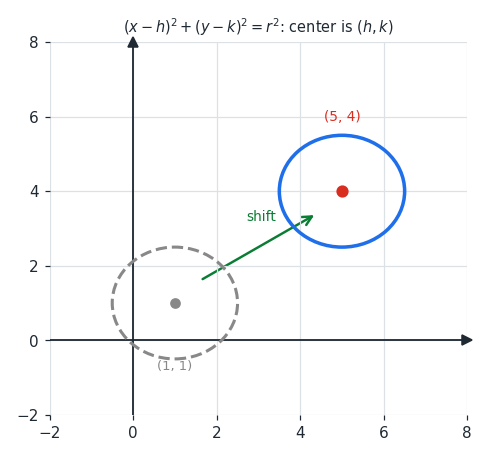
Shifting the center just means changing h and k. A circle centered at (1,1) with radius 1.5 is (x−1)2+(y−1)2=2.25; moving its center to (5,4) gives (x−5)2+(y−4)2=2.25. The radius is untouched, so the circle is the same size, just in a new place.
Watch the signs in the equation, since the center uses the opposite sign. In (x−5)2, the x-coordinate of the center is +5, and in (y+4)2=(y−(−4))2, the y-coordinate is −4. So a + inside the bracket means a negative coordinate.
To shift by a given amount, adjust each coordinate. Moving a center right by 3 increases h by 3; moving it down by 2 decreases k by 2. Rewrite h and k with the new values and keep r2 exactly as it was.
Worked examples
The circle (x−2)2+(y−3)2=16 is shifted so that its center moves by (4,−2). What is the equation of the new circle? The original center is (2,3), and shifting by (4,−2) moves it to (2+4,3−2)=(6,1). The radius is unchanged, so the new equation is (x−6)2+(y−1)2=16.
A circle has equation (x+3)2+(y−5)2=9, and after a shift its equation becomes (x−2)2+(y+1)2=9. By what vector was the center shifted? Reading the centers from the equations, the original is (−3,5) and the new one is (2,−1). The shift is the change in each coordinate: (2−(−3),−1−5)=(5,−6).
The circle (x−1)2+(y+2)2=4 has its center moved by (−3,5). What is the new center? The original center is (1,−2), and adding the shift gives (1−3,−2+5). So the new center is (−2,3).
Is this one of the topics costing you points?
Take the free 10-question diagnostic for a predicted SAT score and a breakdown of which domains are costing you points.