An SAT micro-topic explainer. Free to read — no account needed.
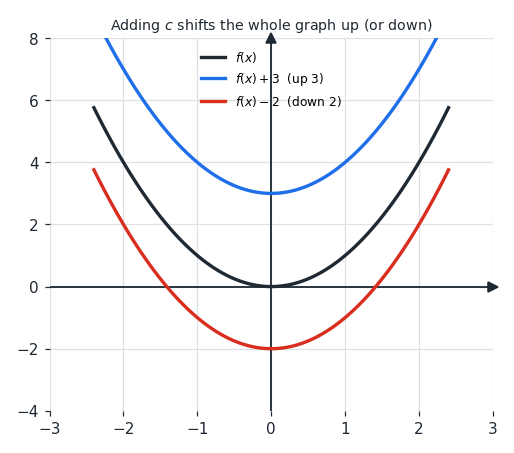
Adding a constant outside the function, as in f(x)+c, shifts the entire graph up or down. A positive c raises every point by c; a negative c lowers it.
Because every point moves by the same amount, the shape stays identical. If f(x)=x2 has its lowest point at (0,0), then f(x)+3=x2+3 has the same U-shape but its lowest point is at (0,3). The curve is simply lifted three units.
A vertical shift changes the y-intercept and any maximum or minimum value. Shifting up by 3 adds 3 to the y-intercept and to the vertex's height. So reading off a new minimum or intercept is just the old value plus c.
This is different from a horizontal shift, which changes x inside the function. Writing f(x−2) moves the graph sideways, while f(x)+2 moves it up. Adding outside the function affects height; changing what goes inside affects left-right position.
Worked examples
If f(x)=x2, describe the graph of f(x)+5. Adding 5 outside the function shifts the whole graph up by 5. So the vertex moves from (0,0) to (0,5), with the same U-shape.
The graph of g(x) has a y-intercept of 4. What is the y-intercept of g(x)−6? Subtracting 6 lowers every point, including the intercept, by 6. So the new y-intercept is 4−6=−2.
Does f(x)+2 shift the graph up or sideways? The 2 is added outside the function, so it changes the height, not the x-position. So the graph shifts up by 2.
Is this one of the topics costing you points?
Take the free 10-question diagnostic for a predicted SAT score and a breakdown of which domains are costing you points.