An SAT micro-topic explainer. Free to read — no account needed.
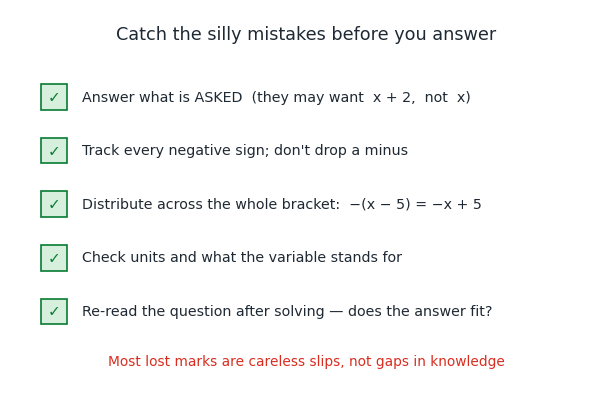
On a hard test, many errors are not about not knowing the maths — they are silly mistakes made in a hurry. Knowing the common traps helps you catch them before they cost a mark.
The most frequent slip is answering the wrong quantity. If you solve 2x=10 to get x=5 but the question asks for x+1, the answer is 6, not 5. Always check what the question actually wants before choosing.
Sign and distribution errors are the next most common. Dropping a minus turns −(x−5) into −x−5 instead of the correct −x+5. Distribute across the whole bracket and keep track of every negative as you go.
So the fix is a quick habit: solve, then re-read and sanity-check. Confirm the answer matches the quantity asked, the sign is right, and the size is reasonable. A few seconds of checking saves marks that were never really in doubt.
Worked examples
Solve 3x=12, then give the value of x+4. (A) 4 (B) 8 Solving gives x=4, but the question asks for x+4, not x. So the answer is 4+4=8, which is (B); choosing (A) is the silly-mistake trap.
Simplify −(x−3)+2x. (A) x+3 (B) 3x−3 Distributing the minus gives −x+3, so −x+3+2x=x+3. Dropping the sign would wrongly give 3x−3, so the correct answer is (A).
A rectangle is x cm wide and twice as long. If x=5, what is its perimeter? (A) 15 (B) 30 The length is 10, so the perimeter is 2(5)+2(10)=30; answering 15 would come from forgetting to double or from finding just half. So the correct answer is (B).
Is this one of the topics costing you points?
Take the free 10-question diagnostic for a predicted SAT score and a breakdown of which domains are costing you points.