An SAT micro-topic explainer. Free to read — no account needed.
Simplifying an expression means rewriting it in the cleanest equal form, using whatever tool fits — combining like terms, factoring, or cancelling.
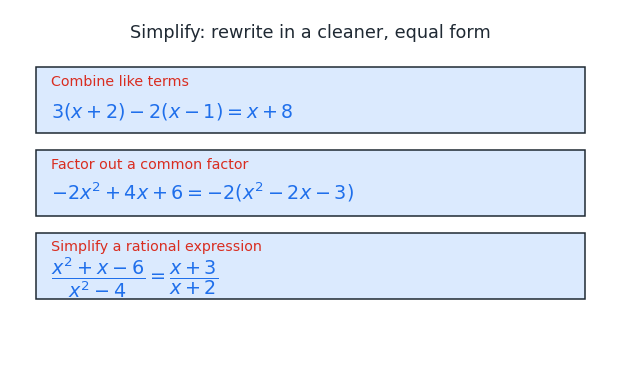
The most basic move is to combine like terms after expanding. For 3(x+2)−2(x−1), expand to 3x+6−2x+2, then combine to get x+8. Watch the signs when a minus sits in front of a bracket.
Another move is to factor out a common factor, which is especially handy before solving an equation. In −2x2+4x+6=0, every term shares a factor of −2, so pull it out: −2(x2−2x−3)=0. Dividing by −2 leaves the much simpler x2−2x−3=0, which factors as (x−3)(x+1)=0.
With a rational expression, factor the top and bottom and cancel what they share. For x2−4x2+x−6, factor to (x+2)(x−2)(x+3)(x−2), then cancel the common (x−2) to leave x+2x+3. Whatever the tool, the goal is an equivalent expression that is simpler to read, solve, or compare.
Worked examples
Factor out the common factor to simplify 5x2−10x. Both terms share 5x, so pull it out: 5x(x−2). So 5x2−10x=5x(x−2).
Simplify the rational expression x2+2x−8x2−16. Factor top and bottom: (x+4)(x−2)(x−4)(x+4). Cancel the common (x+4) to get x−2x−4.
Simplify 4(x−3)−2(2x+1). Expand: 4x−12−4x−2. The x-terms cancel, leaving −14.
Is this one of the topics costing you points?
Take the free 10-question diagnostic for a predicted SAT score and a breakdown of which domains are costing you points.