An SAT micro-topic explainer. Free to read — no account needed.
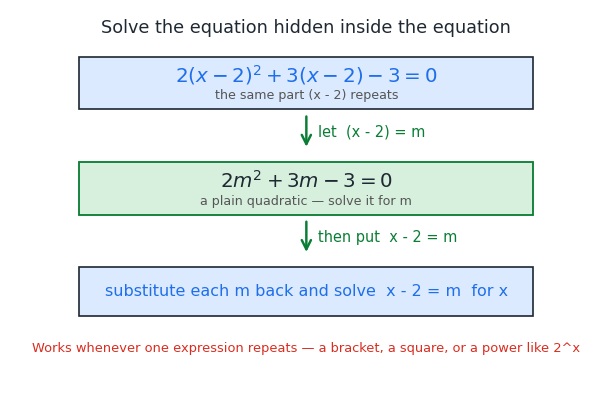
Some equations look hard but contain a smaller equation inside them. When one expression repeats, replace it with a single letter, solve the simpler equation that results, and then substitute back to find the original variable.
Take 2(x−1)2−5(x−1)+3=0, where (x−1) repeats. Let m=x−1, turning it into the plain quadratic 2m2−5m+3=0, which factors as (2m−3)(m−1)=0, so m=23 or m=1. Now substitute back: x−1=23 gives x=25, and x−1=1 gives x=2.
The same trick works with exponents. In 22x−6(2x)+8=0, notice that 22x=(2x)2, so letting m=2x gives m2−6m+8=0. That factors as (m−2)(m−4)=0, so m=2 or m=4; then 2x=2 gives x=1, and 2x=4 gives x=2.
So the method is always the same: spot the repeated expression, replace it with a single letter, solve the resulting quadratic, and substitute back. Watch for solutions you must reject — for instance 2x can never be zero or negative, so a negative value of m would be thrown out. The hard-looking equation is really just a simple one in disguise.
Worked examples
Solve (x−2)2+3(x−2)−4=0. The expression (x−2) repeats, so let m=x−2, giving m2+3m−4=0. This factors as (m+4)(m−1)=0, so m=−4 or m=1. Substituting back, x−2=−4 gives x=−2, and x−2=1 gives x=3.
Solve 22x−5(2x)+4=0. Let m=2x, so 22x=m2 and the equation becomes m2−5m+4=0. This factors as (m−1)(m−4)=0, so m=1 or m=4. Substituting back, 2x=1 gives x=0, and 2x=4 gives x=2.
Solve 3(22x)−2(2x)−1=0. Let m=2x, so 22x=m2 and the equation becomes 3m2−2m−1=0. This factors as (3m+1)(m−1)=0, so m=−31 or m=1; but 2x cannot be negative, so reject m=−31. That leaves 2x=1, which gives x=0.
Is this one of the topics costing you points?
Take the free 10-question diagnostic for a predicted SAT score and a breakdown of which domains are costing you points.