An SAT micro-topic explainer. Free to read — no account needed.
"Advanced" inequalities are ones where you handle a range at once or combine several bounds, rather than solving a single simple inequality. The rules are familiar, but you apply them to more than two pieces at a time.
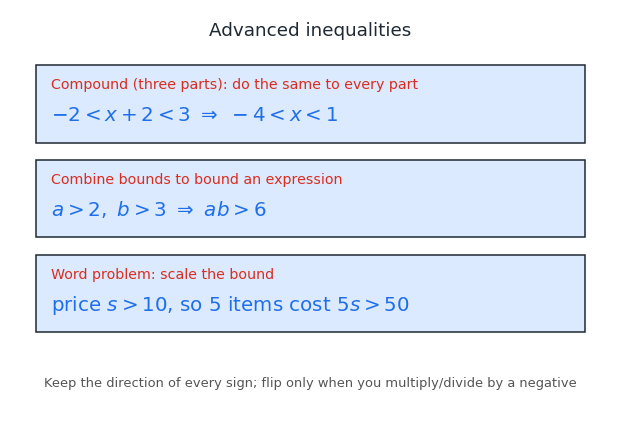
A compound inequality traps a variable between two values, like −2<x+2<3. Whatever you do, do it to all three parts: subtracting 2 throughout gives −4<x<1. The solution is the range of values that satisfy both ends at once.
You can combine two bounds to bound an expression built from them. If a>2 and b>3, then multiplying the two positive bounds gives ab>6, so the smallest ab can approach is 6. The same idea gives a minimum for a sum: a>2 and b>3 make a+b>5.
Word problems often hide a scaled bound. If one item costs s>10 dollars, then 5 identical items cost 5s, and multiplying the bound by 5 gives 5s>50. So the total must be more than $50. Keep every sign's direction the same, and flip it only if you multiply or divide by a negative.
Worked examples
Solve the compound inequality −1≤2x+3<9. Subtract 3 from all three parts: −4≤2x<6. Then divide every part by 2: −2≤x<3.
If a≥4 and b≥5, what is the minimum possible value of ab? Both bounds are positive, so ab is smallest when a and b are at their smallest: a=4 and b=5. So the minimum value of ab is 4×5=20.
Each pencil costs more than $3, and a student buys 4 pencils. What can we say about the total cost? If the price is s>3, then 4 pencils cost 4s, and multiplying the bound by 4 gives 4s>12. So the total is more than $12.
Is this one of the topics costing you points?
Take the free 10-question diagnostic for a predicted SAT score and a breakdown of which domains are costing you points.