An SAT micro-topic explainer. Free to read — no account needed.
For some inequality questions, plugging in the answer choices is faster than solving. You substitute each choice into the inequality and check whether it makes the statement true. The choices that work are your answers, and the ones that fail are eliminated.
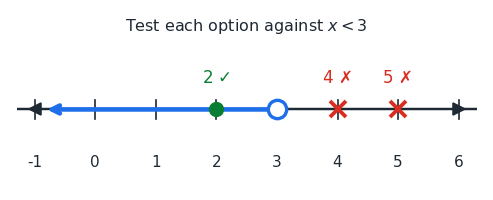
Suppose we want a value that satisfies x<3, and the choices are 2, 4, and 5. Test 2: is 2<3? Yes, so 2 works. Test 4: is 4<3? No, so eliminate it. Test 5: is 5<3? No, so eliminate it.
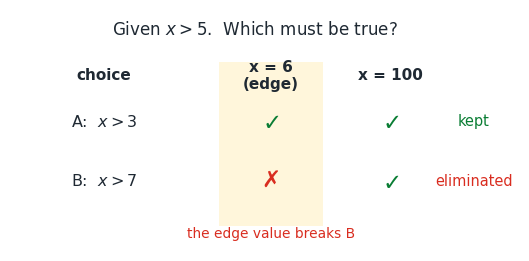
Often you do not need to test every value — just the edge cases. These are the boundary value, 0, or a negative number, and a wrong choice usually breaks at one of them. Say you are told x>5 and asked which must be true, x>3 or x>7. Test a value just past the edge, like x=6: it fits x>5, it makes x>3 true, but it makes x>7 false. That one edge value is enough to eliminate x>7.
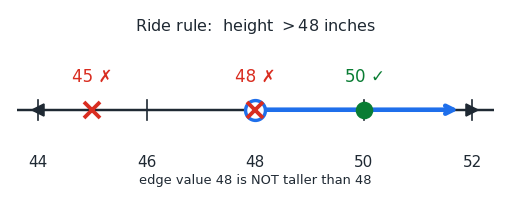
The boundary value itself is worth extra care. For a strict inequality like x>48, the edge value 48 does not count, because 48 is not greater than 48. For x≥48 it would count. Testing that exact edge value quickly rules out any choice that wrongly includes or leaves out the boundary.
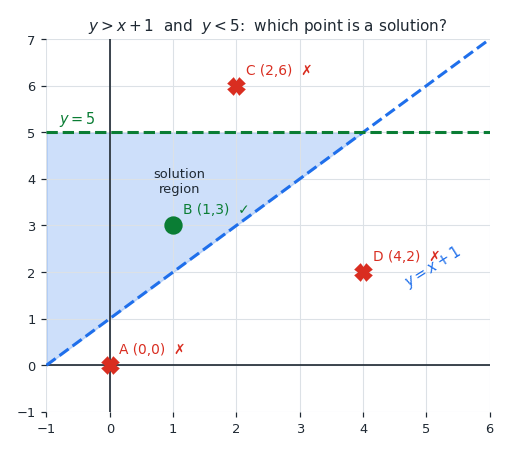
The same approach works for a system of inequalities, where the answer choices are points (x,y). Substitute each point into every inequality in the system. The correct point satisfies all of them; if a point fails even one inequality, eliminate it.
Worked examples
A roller coaster only allows riders taller than48 inches. Three riders are 45, 48, and 50 inches tall. Using the rule h>48, which riders can ride? Test 45: is 45>48? No. Test 48: is 48>48? No — the rule says taller than 48, and 48 is not taller. Test 50: is 50>48? Yes. So only the 50-inch rider can go on.
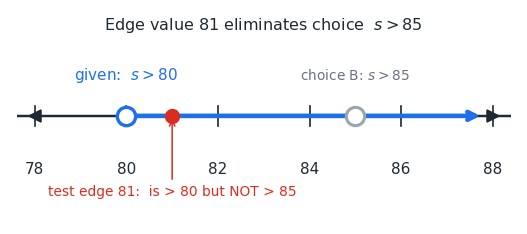
A student scored more than 80 on a test, so s>80. A tutor claims two things must be true: s>75 and s>85. Which one must be true? Test a value just past the edge, like s=81: it satisfies s>80. Check s>75: 81>75 is true. Check s>85: 81>85 is false. The edge value 81 breaks s>85, so only s>75 must be true.
On a cold day the temperature t is below zero, so t<0. Which expression must also be below zero: 2t or t+3? Test an edge value close to 0, like t=−1: 2t=2(−1)=−2, which is below zero. t+3=−1+3=2, which is not below zero. The edge value near 0 breaks t+3, so only 2t must be below zero.
Which point is a solution of the system y>x+1 and y<5: (0,0), (1,3), (2,6), or (4,2)? A solution must satisfy both inequalities, so substitute each point into both. (0,0): is 0>0+1? No, so eliminate it. (1,3): is 3>1+1? Yes. Is 3<5? Yes. It works. (2,6): is 6<5? No, so eliminate it. (4,2): is 2>4+1? No, so eliminate it. Only (1,3) satisfies both, so it is the solution.
Is this one of the topics costing you points?
Take the free 10-question diagnostic for a predicted SAT score and a breakdown of which domains are costing you points.