An SAT Math micro-topic under Solving linear equations and inequalities (Algebra). Free to read — no account needed.
An inequality compares two sides using <, >, ≤, or ≥ instead of =. To solve it, you find all the values of x that make it true. The steps are the same as solving an equation: gather the x-terms on one side and the numbers on the other.
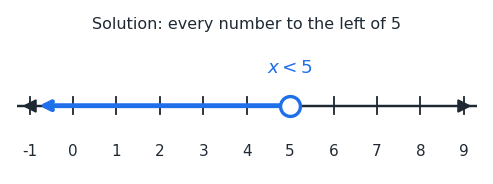
Take 3x+5<2x+10. Subtract 2x from both sides: x+5<10. Subtract 5 from both sides: x<5. So every number less than 5 is a solution.
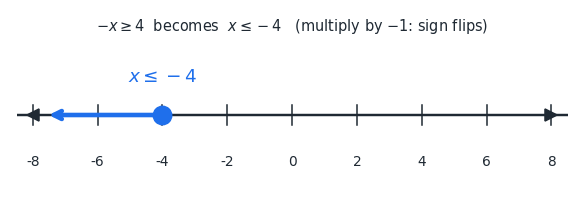
Here is the one rule that is different from equations. If you multiply or divide both sides by a negative number, flip the inequality sign. For example, −x≥4. Multiply both sides by −1, and the ≥ becomes ≤, giving x≤−4.
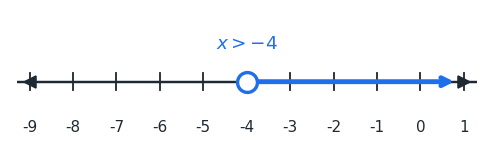
The answer to an inequality is usually a range, not a single number. On a number line, an open circle means the endpoint is not included (for < or >). A filled circle means the endpoint is included (for ≤ or ≥).
A system of inequalities is two or more inequalities at once. A point is a solution only if it satisfies every inequality in the system. If it fails even one, it is not a solution.
Worked examples
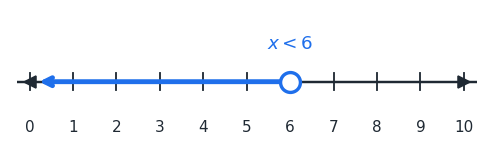
Solve 2x+3<x+9. Subtract x from both sides: x+3<9. Subtract 3 from both sides: x<6.
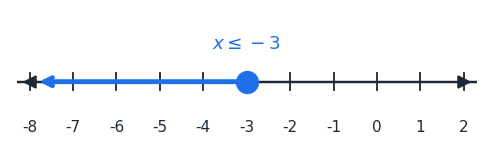
Solve 4−2x≥10. Subtract 4 from both sides: −2x≥6. Divide both sides by −2 and flip the sign: x≤−3.
Solve −3x<12. Divide both sides by −3 and flip the sign: x>−4. So every number greater than −4 is a solution.
Is this one of the topics costing you points?
Take the free 10-question diagnostic for a predicted SAT score and a breakdown of which domains are costing you points.