An SAT micro-topic explainer. Free to read — no account needed.
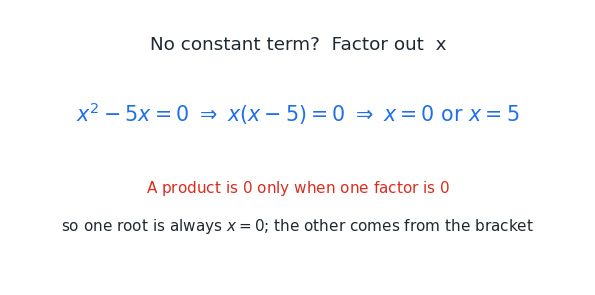
A quadratic of the form ax2+bx=0 — with the constant term c=0 — is the easiest kind to solve. Both terms share a factor of x, so you can factor it out instead of reaching for the quadratic formula.
Factoring out x turns x2−5x=0 into x(x−5)=0. A product equals zero only when one of its factors is zero, so either x=0 or x−5=0. This gives the two solutions x=0 and x=5.
Notice that one solution is alwaysx=0 when c=0. That is because x is a factor of the whole expression, so setting that factor to zero is always allowed. The other solution comes from setting the bracket equal to zero.
This also works when the x-term has a coefficient. For 0.2x(40−x)=0 the expression is already factored, so x=0 or 40−x=0, giving x=0 or x=40. These are often the points where a curve crosses the x-axis.
Worked examples
Solve x2−7x=0. Factor out x: x(x−7)=0. So x=0 or x−7=0, giving x=0 or x=7.
At which points does the line y=x meet the parabola y=x2? Setting them equal, x2=x, so x2−x=0 and x(x−1)=0. Then x=0 or x=1, giving the points (0,0) and (1,1).
Solve 3x2+12x=0. Factor out 3x: 3x(x+4)=0. So 3x=0 or x+4=0, giving x=0 or x=−4.
Is this one of the topics costing you points?
Take the free 10-question diagnostic for a predicted SAT score and a breakdown of which domains are costing you points.