An SAT Math micro-topic under Operations with polynomials (Advanced Math). Free to read — no account needed.
A binomial is a two-term expression like x+3. Multiplying binomials can be slow, but three special products show up again and again. Learning them saves time on both expanding and factoring.
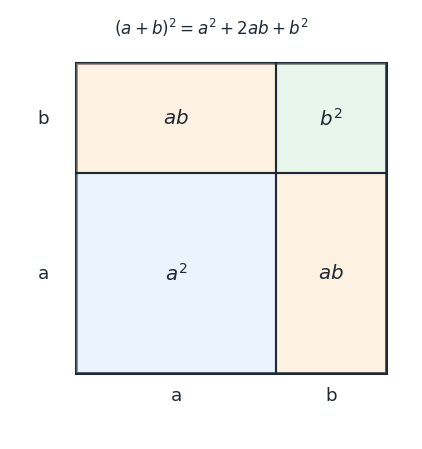
The first is the square of a sum: (a+b)2=a2+2ab+b2. Picture a square with side a+b. It splits into an a2 square, a b2 square, and two ab rectangles. Adding the pieces gives a2+2ab+b2, so notice the middle term is 2ab, not just ab.
The square of a difference is almost the same: (a−b)2=a2−2ab+b2. The only change is the middle sign, which is now negative. For example, (x−4)2=x2−8x+16.
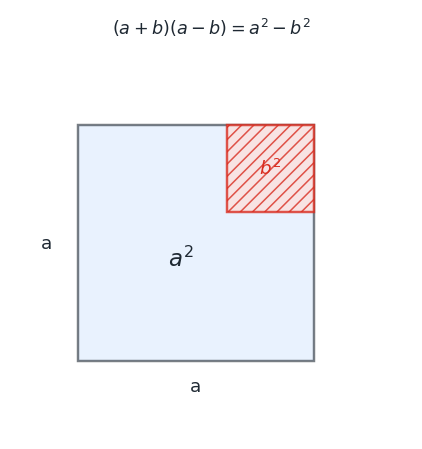
The third pattern is the difference of squares: (a+b)(a−b)=a2−b2. The two middle terms cancel, so no x-term is left. For example, (x+6)(x−6)=x2−36.
These patterns appear all over the SAT. The equation of a circle uses (x−a)2 and (y−b)2. And spotting a2−b2 lets you factor it straight into (a+b)(a−b).
Worked examples
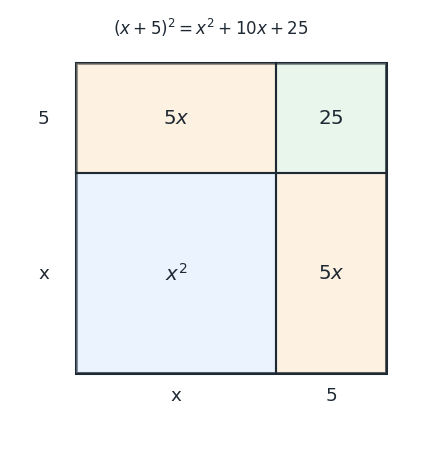
Expand (x+5)2. Use (a+b)2=a2+2ab+b2 with a=x and b=5. So (x+5)2=x2+2(x)(5)+25=x2+10x+25.
Expand (2x−3)2. Use (a−b)2=a2−2ab+b2 with a=2x and b=3. So (2x)2−2(2x)(3)+32=4x2−12x+9.
Expand (x+4)(x−4). This is a difference of squares, (a+b)(a−b)=a2−b2, with a=x and b=4. So (x+4)(x−4)=x2−16.
Is this one of the topics costing you points?
Take the free 10-question diagnostic for a predicted SAT score and a breakdown of which domains are costing you points.