An SAT micro-topic explainer. Free to read — no account needed.
To square a number means to multiply it by itself, like 52=25. A square is never negative, because a positive times a positive and a negative times a negative are both positive. So (x+1)2≥0 for every value of x.
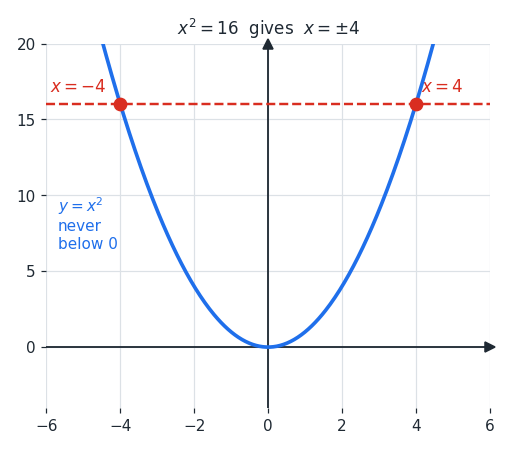
A square root undoes a square. When you solve an equation like x2=16, you must allow both signs, because 42=16 and (−4)2=16 are both true. So x=±16=±4.
Be careful: the square-root symbolx on a known positive number means only the positive root. So 4=2, not ±2. The two signs appear only when you are solving for a variable that was squared.
A square root of any real expression is also ≥0, so 2x+3≥0 whenever it is defined. And an equation like x2=−5 has no real solution, because a square can never be negative.
This idea helps when rearranging formulas. For example, from A=πr2 you divide by π and take the square root to get r=πA. When the variable stands for a real quantity like a length or speed, you keep only the positive root.
Worked examples
Solve x2=49. Take the square root of both sides, keeping both signs: x=±49. So x=7 or x=−7.
What is 81? The square-root symbol on a known positive number gives only the positive root. So 81=9, not ±9.
The area of a circle is A=πr2. Solve for the radius r. Divide both sides by π: πA=r2. Take the square root, and since a radius is a length we keep the positive root: r=πA.
Is this one of the topics costing you points?
Take the free 10-question diagnostic for a predicted SAT score and a breakdown of which domains are costing you points.