An SAT micro-topic explainer. Free to read — no account needed.
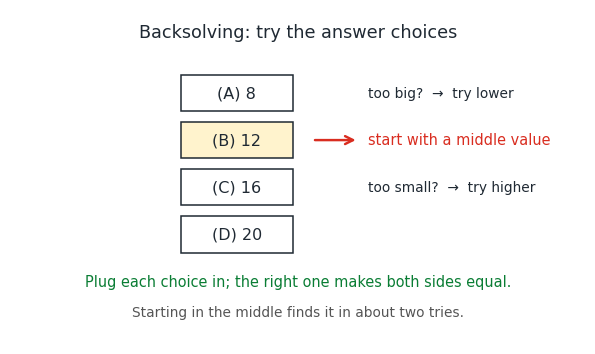
On many multiple-choice questions you can backsolve — test the answer choices in the equation instead of solving it algebraically. This is handy when solving directly would mean squaring, clearing fractions, or wrestling with a quadratic.
The right choice is the one that makes both sides of the equation equal. For x=2+x, testing x=2 gives 2+2=4=2, so the left side equals the right side. That confirms x=2 without squaring anything.
Choose the order of testing wisely by starting near the middle. If a middle choice makes the left side too big, the answer must be a smaller choice; if too small, a larger one. Starting in the middle tells you which direction to go, so you rarely need more than two tries.
Backsolving also works for systems and word problems. To find which point solves y=x2−6x+8 and y=x+2, plug each candidate point into both equations and keep the one that satisfies both. The point (1,3) gives 3=1−6+8 and 3=1+2, so both hold and it is the solution.
Worked examples
Solve x=6+x by testing the choices. (A) x=2 (B) x=3 Test x=3: 6+3=9=3, so the left side equals the right side. Testing x=2 gives 8≈2.83=2, so (B) is correct.
Which point is a solution to y=x2−4x+5 and y=x+1? (A) (2,3) (B) (4,5) Test (2,3): the first equation gives 4−8+5=1=3, so it fails. Test (4,5): 16−16+5=5 and 4+1=5, so both hold and (B) is correct.
In x6=10+x8, which value of x works? (A) x=2 (B) x=−51 Test x=2: left is 3, right is 10+4=14, far apart, so no. Test x=−51: left is −30, right is 10−40=−30, so both sides match and (B) is correct.
Is this one of the topics costing you points?
Take the free 10-question diagnostic for a predicted SAT score and a breakdown of which domains are costing you points.