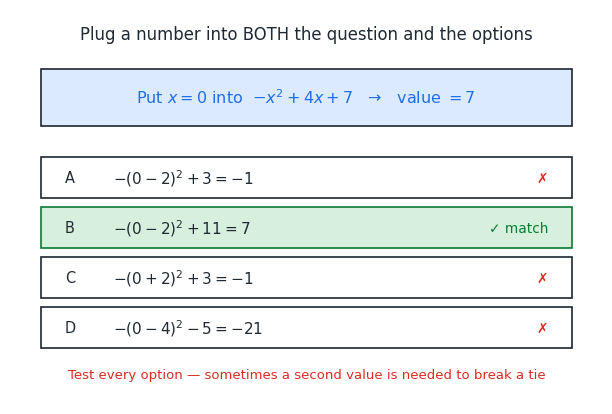
Tallying the question and answer option when substituting numbers
An SAT micro-topic explainer. Free to read — no account needed.
When a question's answer choices are algebraic expressions, you can avoid heavy algebra by substituting numbers. Choose a convenient value, compute the question's value with it, then compute each option and match.
The matching option is the one that gives the same value as the question. Substituting x=0 into −x2+4x+7 gives 7, so the correct choice must also give 7 at x=0. An option like −(x−2)2+11 gives −4+11=7, so it matches.
Test every option before you commit, not just until you find one match. Sometimes a chosen value leaves two options both looking correct, because it happens to make them equal. When that occurs, substitute a second value, and only the truly equivalent option matches both times.
Pick values that keep the arithmetic light and avoid breaking the expression. Zero is often ideal because it cancels many terms, but avoid any value that makes a denominator zero. Substituting into the question and the options together turns a comparison of expressions into a comparison of numbers.
Worked examples
Which expression equals x2−6x+5? Test x=0. (A) (x−1)(x−5) (B) (x+1)(x+5) At x=0 the question gives 5; (A) gives (−1)(−5)=5 and (B) gives (1)(5)=5, so both match — test x=1. The question gives 0, (A) gives (0)(−4)=0 and (B) gives (2)(6)=12, so only (A) matches.
Which expression equals 2x2+3x? Substitute x=1. (A) x(2x+3) (B) x(x+3) At x=1 the question gives 5; (A) gives 1×5=5, while (B) gives 1×4=4. Only (A) matches, so (A) is correct.
Which choice gives −6 when k=0, matching (32k−3)(4k−k2+2)? (A) 31(18k−18) (B) 31(6k+18) At k=0 the question gives (−3)(2)=−6; (A) gives 31(−18)=−6, while (B) gives 31(18)=6. Only (A) matches, so (A) is correct.
Is this one of the topics costing you points?
Take the free 10-question diagnostic for a predicted SAT score and a breakdown of which domains are costing you points.