An SAT Math micro-topic under Linear relationship word problems (Algebra). Free to read — no account needed.
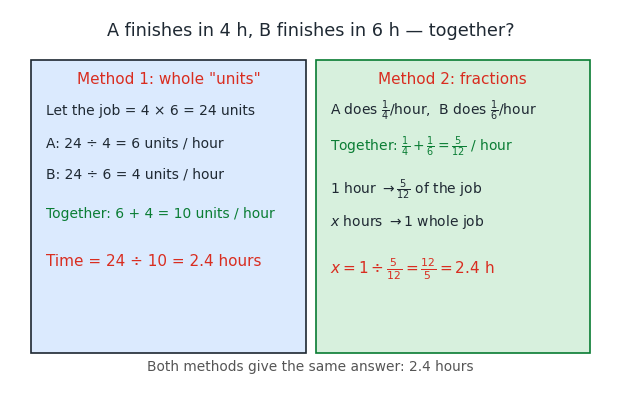
Here is a complete question to start with: A takes 4 hours to finish a job, and B takes 6 hours to finish the same job. Working together, how long do they take? The idea is to combine how fast each one works, and there are two clean ways to do it.
Method 1 — count in whole units. Pretend the whole job is a convenient number of units, say 4×6=24. Then A, who takes 4 hours, does 24÷4=6 units each hour, and B does 24÷6=4 units each hour; together that is 6+4=10 units each hour, so the 24-unit job takes 24÷10=2.4 hours.
Method 2 — use fractions. In one hour A does 41 of the job and B does 61, so together in one hour they do 41+61=125 of the job. Now use the unitary idea: if 1 hour →125 of the job, and x hours →1 whole job, then cross-multiplying gives x=1÷125=512=2.4 hours.
The rate idea also covers someone undoing work. Suppose a tap fills a tank in 3 hours while an open drain empties the full tank in 6 hours. The tap adds 31 per hour and the drain removes 61, so the net rate is 31−61=61 per hour, and the tank fills in 1÷61=6 hours.
It also handles staggered starts, where one person begins alone. Say A can finish a job in 5 hours and B in 10 hours, and A works alone for 2 hours before B joins. Take the job as 10 units, so A does 2 units per hour and B does 1; in 2 hours alone A does 4 units, leaving 6 units, and together they do 3 units per hour, so the rest takes 6÷3=2 more hours.
Worked examples
A finishes a job in 3 hours and B finishes it in 6 hours. How long do they take together? In one hour they do 31+61=62+61=21 of the job. So the whole job takes 1÷21=2 hours.
A tap fills a tank in 5 hours, and an open drain can empty the full tank in 10 hours. If both are left open, how long does the tank take to fill? The tap adds 51 of the tank per hour while the drain removes 101, so the net rate is 51−101=102−101=101 per hour. So the tank fills in 1÷101=10 hours.
A can finish a job in 6 hours and B in 12 hours. A works alone for 2 hours before B joins. How much longer does the job take after B joins? Take the whole job as 12 units, so A does 2 units per hour and B does 1 unit per hour. In 2 hours alone, A completes 2×2=4 units, leaving 12−4=8 units. Once B joins, together they do 2+1=3 units per hour, so the remaining 8 units take 8÷3=38 hours, about 2.7 hours.
Is this one of the topics costing you points?
Take the free 10-question diagnostic for a predicted SAT score and a breakdown of which domains are costing you points.