Isolating quantities
How the SAT tests this, with worked examples — plus the 3 skills it covers. Free to read, no account needed.
These questions give a formula and ask you to rearrange it for a different letter. There is nothing new to learn: it is the same reverse-order undoing used to solve an equation, with letters standing where numbers usually sit.
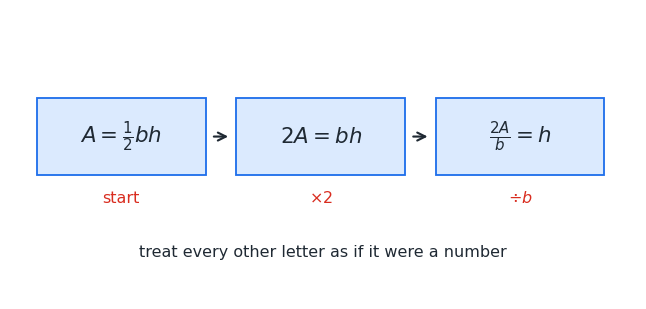
The habit that makes this easy is treating every other letter as though it were a number. To get out of , you would multiply by and divide by if were , so do exactly that.
Work in reverse order of operations, undoing the outermost thing first. If the target letter is inside a square root, square both sides before anything else; if it is in a denominator, multiply up first.
When the target appears twice, the method changes: gather all its terms on one side, factor it out, then divide by the bracket.
A useful check is to substitute simple numbers into both the original and the rearranged version. If they disagree, the rearrangement is wrong.
Worked examples
Solve for .
Multiply by , then divide by
Multiply by , then divide by
Solve for .
Undo the square root first by squaring both sides
Undo the square root first by squaring both sides
Solve for .
Here appears twice, so collect and factor
Here appears twice, so collect and factor
Is isolating quantities costing you points?
Take the free 10-question diagnostic for a predicted SAT score and a breakdown of which domains are costing you points.