Operations with rational expressions
How the SAT tests this, with worked examples — plus the 2 skills it covers. Free to read, no account needed.
A rational expression is a fraction with polynomials top and bottom, and the rules are the ones you already use with numerical fractions.
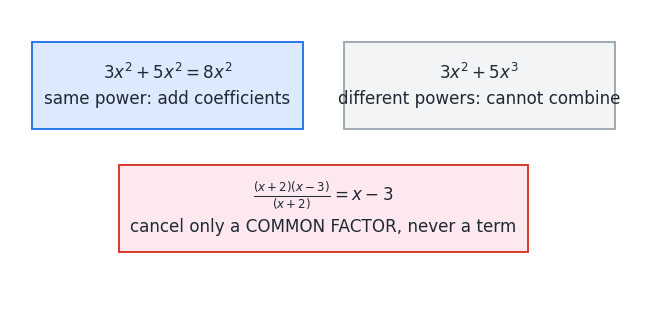
To simplify, factor the numerator and denominator completely, then cancel any factor they share. The crucial restriction is that you may cancel a factor but never a single term: in the does not cancel, because the top is a sum rather than a product.
To add or subtract, you need a common denominator exactly as with numbers. To multiply, multiply across and then cancel. To divide, multiply by the reciprocal.
Any value making a denominator zero is excluded, because the expression is undefined there — and that stays true even after cancelling. In , the simplified form is , but is still not allowed.
Worked examples
Simplify .
The bracket is a common factor, so it cancels
The bracket is a common factor, so it cancels
Can the in be cancelled?
No. The numerator is a sum, not a product, so is not a common factor. Only factors cancel.
No. The numerator is a sum, not a product, so is not a common factor. Only factors cancel.
Is operations with rational expressions costing you points?
Take the free 10-question diagnostic for a predicted SAT score and a breakdown of which domains are costing you points.